


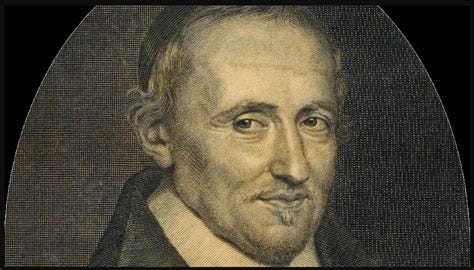
Image: Pierre Gassendi, felsefe.gen.tr
Across the globe today, most people know that the cosmos—and everything in it—is made up of tiny particles called atoms. It is commonly understood that atoms are the most basic building blocks of reality and that modern science is founded upon our understanding of atomic matter in motion. Such was not always the case, however.
While the idea of atoms as tiny, indivisible particles (atomos) moving in an infinite void was first suggested by the Ancient Greek philosophers Democritus and Epicurus over 2,300 years ago, the idea of atoms was soon rejected by an even more prominent Ancient Greek philosopher named Aristotle. After Aristotle, practically no one continued to believe in such atoms—or in the possibility of an empty void—for over fifteen hundred years.
Then, in the early 1600s, the French physicist, philosopher, historian, priest, and professor of mathematics, Pierre Gassendi, revived and revised the atomism of Epicurus and established it as the foundation of the Scientific Revolution. Parting philosophical ways with previous generations who attempted to explain all motion in terms of the inherent natures of Aristotle’s five elements—earth, air, fire, water, and ether—Gassendi contended that all physical phenomena could be mechanically and quantitatively understood in terms of atomic matter and motion.
A contemporary of Galileo and known as the French “Francis Bacon,” Gassendi was one of the first advocates of the experimental method, and he was also one of the most internationally influential pioneers of the mechanical philosophy in science. Introducing a revised philosophy of ancient atomism into the mainstream of European thought, Gassendi’s groundbreaking rehabilitation of the atomistic philosophy and his erudite critique of Aristotelian physics influenced and inspired the work of Robert Boyle, Sir Isaac Newton, John Dalton, and many other scientists of the early Royal Society in Great Britain.
An Atomic Vision Beyond the Ancients
The original atomism of Democritus and Epicurus envisioned atoms as tiny, indestructible particles that could neither be created nor destroyed. For Epicurus, atoms were infinite in number, and he believed that they had existed forever. Everything that was anything, according to Epicurus, was made of material atoms—even the gods. Epicurus rejected the existence of the Platonic forms, explicitly denied the idea of an immaterial, immortal human soul, and argued that there was no such thing as an immaterial thing or being, with the one exception of the infinite void (which is simply empty space).1
Because he affirmed that nothing comes into existence from nothing, Epicurus believed that the universe had no beginning, had always existed, and would always exist. He taught that the cosmos that we now inhabit is only a temporary collection of atoms, and that it is only one of an infinite number of such universes—all of which spontaneously come into existence by chance and then dissolve away. For him, the gods have no influence on the course of events or human lives.
While Gassendi embraced Epicurus’ idea of atoms as tiny particles, he explicitly rejected his metaphysical conclusions. Emerging from a Biblical understanding of created reality, Gassendi’s motivation for introducing atomism into modern science was primarily theological and philosophical. He believed that “all things were created by God according to weight and measure,”2 and accordingly thought that the atomic philosophy was—from among the ancient philosophies—the most harmonious with this vision.
Conceiving a concept of atoms that went beyond that of the Ancient Greeks, when Gassendi first introduced atomism into modern science in the 1600s, he drastically differed from Epicurus by affirming that God created all the atoms at the beginning of the universe. Moreover, he argued that God created only a finite number of atoms. Far from leaving such atoms to do their work by chance, Gassendi said that God continued to govern the atoms through his laws of nature. Beyond this, Gassendi insisted that God’s atomic laws of nature were directed towards providential ends related to the evolution of the cosmos and the final fulfillment of the creation.
From Indeterministic Freedom to the Mind of God
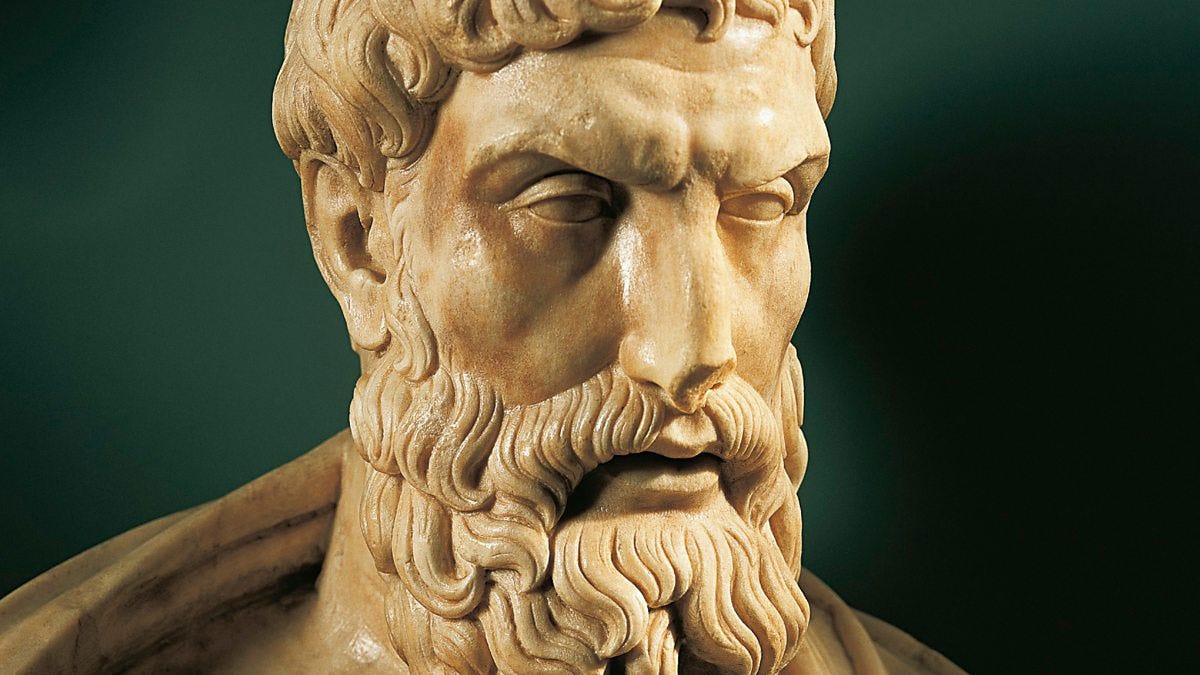
Image: Epicurus, epicureanglobalexchange.com
For Gassendi and other Early Modern scientists, the laws of nature were an expression of God’s will for the cosmos, and free will was seen as a gift from God to human nature. Strongly affirming human freedom,3 Gassendi held that an indeterministic “unpredictable swerve” in atomic motion left open the physical possibility of free will.4 He believed that, without contradiction or competition, the natural laws that govern atoms worked together with human free will as part of God’s purposeful plan.
Thus, while Gassendi retained the fundamental feature of Epicurean natural philosophy, namely, an atomistic explanation of the natural world, his “insistence on a creationist, providential account of nature and human life was a complete and explicit repudiation of Epicurus’ intentions.”5
Gassendi strongly disagreed with ancient atomism’s materialistic and atheistic outlook. Rather, Gassendi argued that an atomic natural philosophy not only served as a scientific foundation for human freedom but also led scientists (known then as natural philosophers) to contemplate the Mind of God. As Gassendi explains:
Natural philosophy (Physiologia) is the contemplation of the natural universe of things from the magnitude, variety, disposition, and beauty of its wonders. . . . Our natural reason deduces from it that there exists a most wise, powerful, and good, Divine will (Numen) by which it is governed . . . , so that we acknowledge this Divine will for the greatness of his excellence and beneficence. And reverence, which is the true religion, must be cultivated. This religion teaches that “God is the cause that created the world, and he rules it with general providence and also special providence for humanity.”6
It was clear to him that a created cosmos made of atoms would be “utterly contingent on Divine will,” and his faith in such cosmic contingency expressed itself in a “conviction that empirical methods are the only way to acquire knowledge about the natural world and the matter of which all physical things are composed.”7 Gassendi believed that Epicurus and the ancient atomists committed “the gravest error in asserting that chance, not God, is the cause of the world.”8
With his new and revised scientific atomism as the foundation of a new mechanical philosophy of science, Gassendi expected that the work of God in creation would always be apparent and that human minds would never again fall into the philosophical error of atheism.
Margaret J. Osler, Divine Will and the Mechanical Philosophy: Gassendi and Descartes on Contingency and Necessity in the Created World (New York : Cambridge University Press, 1994) 38.
Wisdom of Solomon 11:20.
Gary Ferngren, History of Science and Religion in the Western Tradition, (New York: Garland, 2000), 172.
Peirre Gassendi quoted in Lisa T. Sarasohn, Gassendi’s Ethics: Freedom in a Mechanistic Universe (Ithaca, NY: Cornell University Press, 1996).
Osler, Divine Will and the Mechanical Philosophy, 45.
Pierre Gassendi, Syntagma philosophicum, in Opera omnia, vol. 1, p. 128.
Osler, Divine Will and the Mechanical Philosophy 222.
Pierre Gassendi, Syntagma philosophicum, in Opera omnia, vol. 1, pp. 320-1.
