


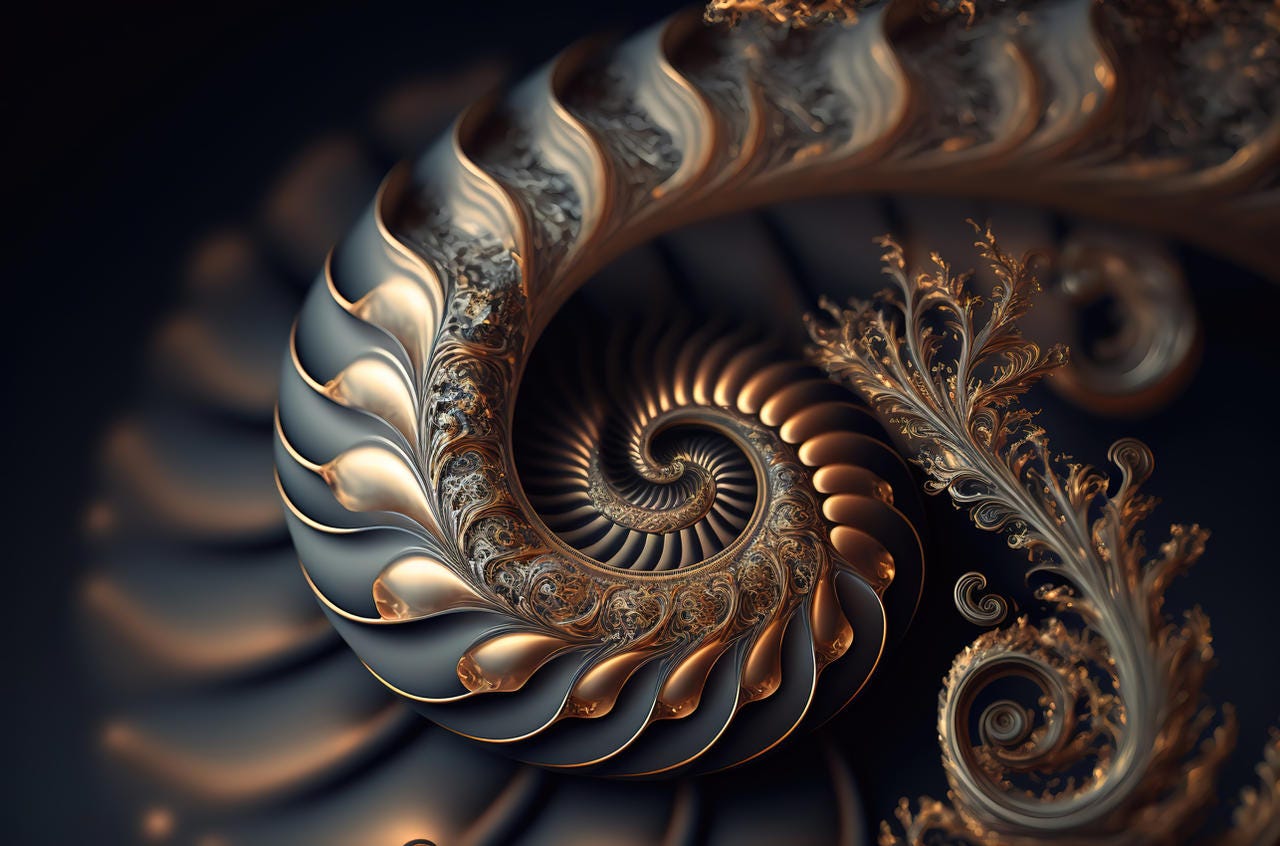
Image: deviantart.com
The cosmos is full of patterns that structure both physical and biology reality—from the exquisite organization of the periodic table underlying all physical interactions, to the Fibonacci spiral ubiquitously governing biological phenomena. As the source of great beauty and as pointers to deeper mathematical truths, these patterns have inspired both the philosophers of old and the scientists and mathematicians of the present to reflect on where these patterns ultimately come from. Are they random artifacts of chance and natural selection, or is their source found in some deeper transcendent realm?
Plato’s Transcendent Patterns
Over 2,300 years ago, the Ancient Greek philosopher Plato contended that the patterns of nature and mathematics are ultimately derived from a transcendent immaterial space of unchanging Forms or Ideas that exists beyond the physical world. While this Platonic space is not detectable by our five senses, it can be comprehended by our minds, and the patterns within this meta-physical space were thought by Plato to inform the patterns that we see in the physical world.
For example, Plato held that a perfect right triangle, as described by mathematicians, is actually a description of the transcendent Form or Idea of a right triangle that exists in an informational dimension that is independent of both human minds and any human depiction of it. Thus, the information governing the pattern—or form—of the triangle exists in a Platonic space beyond any particular physical instantiations of the triangle.
The Platonic Biology of D’Arcy Wentworth Thompson
In the late 19th and early 20th centuries Plato’s understanding of a transcendent reality of forms inspired Scottish biologist and mathematician Sir D’Arcy Wentworth Thompson to pioneer a mathematical approach to biology. Perceiving universal mathematical patterns in nature, akin to Plato’s ideal Forms, Thompson sought to explain biological forms through mathematical transformations—rather than seeing them as solely shaped by the maximizing fitness of natural selection—and he viewed such forms as manifestations of underlying cosmic laws.
In his masterful volume On Growth and Form, Sir D’Arcy argued that physical laws (like surface tension, pressure, and mechanics) together with mathematical principles inform biological patterns.1 For Thompson, these shapes and patterns within living things—such as the hexagonal arrangement of cells, logarithmic spirals in shells and horns, and transformations between related species—go beyond the historical contingency of Darwinian evolution to reveal recurring geometric forms in the patterns of nature. Demonstrating how simple forces can create complex structures Sir D’Arcy proposed that both the developmental growth of organisms and the historical evolution of all life follow mathematical rules.
The Ingressing Platonic Minds and Forms of Michael Levin
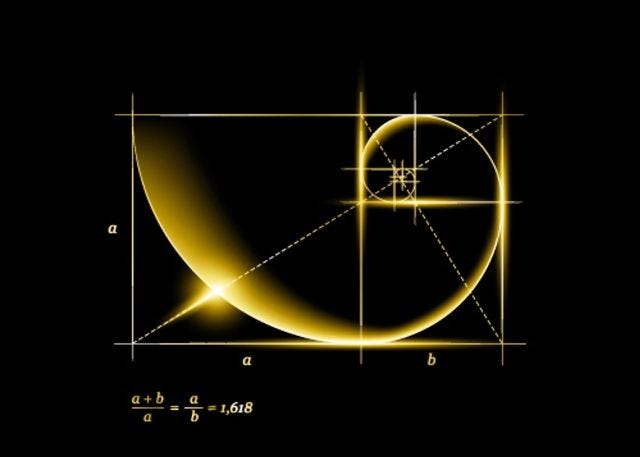
Image: id.pinterest.com
Recently both Plato’s metaphysical forms and Thompson’s mathematical biology have been infused with new scientific life by research led by Harvard and Tufts University developmental and synthetic biologist Michael Levin. Known for his groundbreaking work on the bioelectric control of developmental growth, pioneering research on living robots (xenobots and anthrobots), and the application of this work to healing, regeneration, birth defects, and cancer, Levin has likewise discovered that life makes extensive use of the mathematical facts and properties that “do not have a known physical basis,” but “do have structure and information content.”2
For example, explains Levin, biology harnesses prime numbers, exploits the generic properties of networks and fractal structures, utilizes regulatory networks that are subject to patterns from the field of logic and algebra, and even employs Julia sets and root-finding methods. Levin’s research team has also found that “biological wholes have the ability to achieve specific patterns despite novel conditions, interventions, and changes of environment and of their own parts.”3
For example, during development an organism “knows” the outcome of its final form even if the constituent parts are missing or changed. “Scrambled tadpole heads rearrange to make normal frogs, showing that navigational paths can be altered to find the correct end-state.” Biological systems reach their target goal even when the initial conditions—or genes—are changed and cells work together to create specific structures (even though no individual cell knows what, for example, a finger is or how many there should be) and they “stop when the anatomical goal has been reached.” Patterns inform biological processes at all levels and these patterns persist beyond an organism’s “having the correct copy number of genes, or the correct number or size of its cells.”4
Because the final patterns of biological organisms do not rely on the presence or arrangement of developmental parts or on genetic information, it is clear to Levin that such patterns cannot be located in the genes or the cells themselves. “Genetics and environment,” says Levin, “are not sufficient to explain or make use of the remarkable intelligence of the agential material of life.” Where then, asks Levin, are the remarkable intelligence and detailed forms of the biological patterns coming from and where are such patterns located?
Informational Space
To address this question, Levin proposes that there exists an informational space or meta-physical dimension that impacts the physical products of material reality—“an ordered Platonic space of forms which have a causal influence on the outcomes of evolution and engineering.” Levin contends that “the emergent patterns we observe are not random,” but rather, are the corollaries of “Platonic forms” that “inject information and influence into physical events, such as the growth and form of biological bodies.”5
In addition to informing the structures of physics and life, and the development and growth of organisms, these patterns—according to Levin—also structure minds. In the same way that “the soul of the triangle…relates to real triangular objects,” he says, living beings which cross particular thresholds of complexity are “‘ensouled’ by cognitive patterns.”6 Thus, Levin proposes that the hidden transcendent space of Platonic forms “contains not only simple, low-agency forms such as facts about integers and geometric shapes, but also a wide range of increasingly high-agency patterns, some of which we call ‘kinds of minds.’”
These minds, contends Levin, are patterns “of a non-physical nature” that “ensoul somatic embodiments” and “guide the behavior” of simple physical structures and biological tissue.7 In this way the interface between mathematical truths and physical objects is at the same time the interface between non-physical mind and its physical embodiments. Moreover, the objects of physics, biology, and AI—the embryos, machines, and language models running on PCs or in robots—are just pointers to the structured and highly ordered space of patterns that exist in a transcendent informational dimension.
The minds of living beings, then, are patterns that have ingressed into the nervous systems of carbon-based embodiments even as they have in-formed the structure of such nervous systems. Consequently, says Levin, “what evolution (and bioengineering, and possibly AI) produces are pointers into Platonic space—physical interfaces that enable the ingression of specific patterns of body and mind.”8
All 50 States: A Passport to Your Mind: A new program for paid subscribers.
Each week, you’ll get a guided exploration of a single state of mind — from everyday states like focus, flow, and daydreaming, to deeper emotional, meditative, and contemplative states we all pass through in the course of a human life.
Think of it like a map + travel guide:
1. Clusters / Regions (like US regions):
Everyday States = “The Lowlands” (common terrain of life).
Emotional States = “The Heartlands.”
Meditative States = “The Mountains” (higher elevations of awareness).
Altered / Substance-Induced States = “The Islands.”
Mystical / Transpersonal States = “The Skies.”
Extreme / Edge States = “The Deserts & Depths.”
(If you’re already a paid subscriber and would like to receive the All 50 States email, click here).
Sir D’Arcy Wentworth Thompson, On Growth and Form, (Cambridge University Press, 1917).
Michael Levin, “Ingressing Minds: Causal Patterns Beyond Genetics and Environment in Natural, Synthetic, and Hybrid Embodiments,” American Psychological Association, 6th edition (2025, February 6), 17.
Levin, “Ingressing Minds,” 6.
Levin, “Ingressing Minds,” 8.
Levin, “Ingressing Minds,” 18.
Levin, “Ingressing Minds,” 23-24.
Levin, “Ingressing Minds,” 18.
Levin, “Ingressing Minds,” 2.

Didn't expect this take. Patterns often feel emergent to me, but this Platonic angle is profund.
How does Levin support the notion of fixed Platonic forms as opposed to the evolving forms posited by Sheldrake and Smolin? Or is Levin's claim so general that this question doesn't find purchase there?