


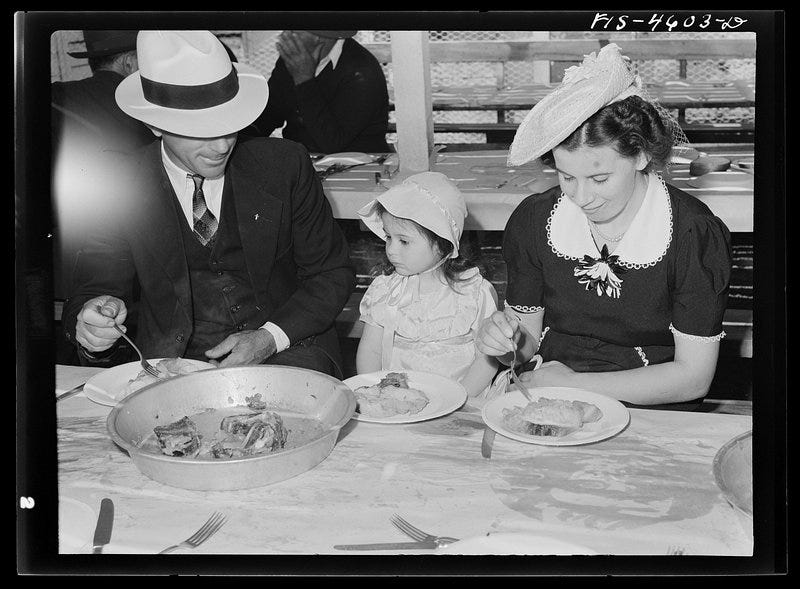
Image: rawpixel.com
You are what you eat. That is certainly true. The molecules that make up your body must come from the food you digest. But it is even more profound that you eat what you are. The meals you choose connect your body to the world—and, in some cases, to your own background. That makes enjoying your food something deeper.
Family Recipe
It was my birthday a week ago. As we celebrated with my family, we placed candles in my favorite applesauce cake—a recipe my mother learned from my great-grandmother, a Lithuanian Jewish immigrant who learned to cook and bake in the old country.
There were no recipe cards; it was all in her head. Trained by her own mother, she simply knew how to make it. She had no measuring spoons. Instead, she cupped her left hand and knew exactly how much of each ingredient to add based on how it filled her palm. She would look at the color of the batter, adjust as she saw fit, and deem it ready for the oven—where it stayed until it reached the perfect color to come out. No timers, just lived experience.
In a bid to preserve this family secret, my mother worked with her on one cake. Before each ingredient was added to the bowl, my mother measured it and wrote down the exact amount. When my great-grandmother made her adjustments, my mom noted those extra bits and added them to her previous measurements. She recorded the oven temperature and timed the baking. When the cake finally emerged, the recipe existed in a form that could be saved and passed down through the generations, becoming a lasting part of our family traditions.
Growing up, every September my mom would bake several of these cakes. They were cut into slices, wrapped in foil, and stored on the freezer door, waiting to be added to my brother’s and my school lunches. The taste of that applesauce cake is the flavor of my childhood—but also of my mother’s, my grandmother’s, and my great-grandmother’s.
When I look at a family tree, most of my forebears are just names. Some I met before I could form memories; others I vaguely recollect. A few I have stories about from my parents and grandparents. But most are simply names. Yet I know that they, too, ate this very applesauce cake. Eating is such a simple act—putting something in your mouth and tasting it. That flavor is fleeting, lasting only a moment. And yet, when I take a bite of that cake, those people whose lives I will never know—whose joys and sufferings, dreams and struggles are lost to time—become connected to me through a shared personal experience. It is one small link in the bridge to those from whom I come.
Collective Memory
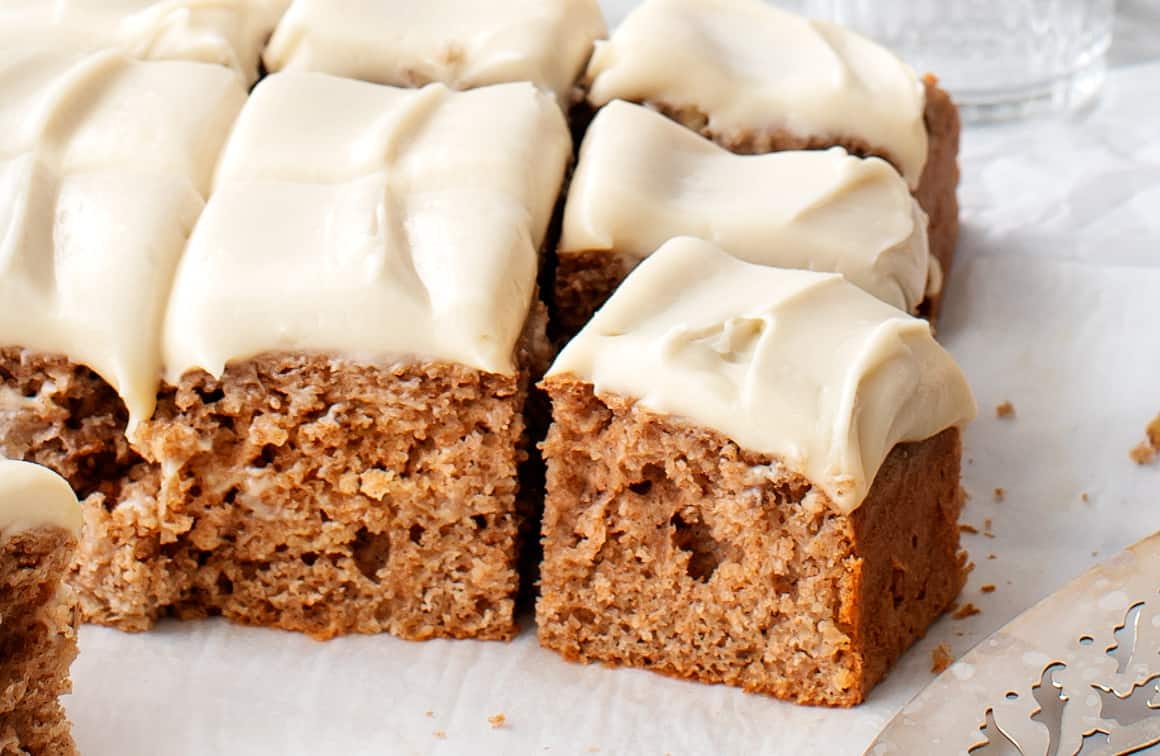
Image: loveandlemons.com
Maurice Halbwachs argued in 1950 that groups possess a collective memory. Different people experience the same event from their own perspectives and thus have unique memories of it, but we share those memories with one another. We use other people’s testimony to fill in gaps in our own understanding and to make connections, thereby giving these events deeper meaning.
As a collective, we round out the partial accounts of our own limited experience to arrive at a common narrative, which then becomes the way we all remember it. Even those who were not born at the time can be socialized into sharing that memory. When we tell and retell the story as it was told to us, it embeds itself within us as if it were our own direct experience. The group remembers, and thus its members remember. We are individuals with our own minds, shaped by our personal biographies, but also by the collective memories of those who socialized us.
Research now suggests that the passing of memory from one generation to the next can be more than sociological—it can be biological. Our DNA encodes much about us, but for some genes, certain environmental factors must be present for them to function. These genes remain dormant until a specific situation activates them. These contextual factors are known as epigenetic influences.
In some cases, traumatic events such as war or genocide can trigger the significant expression of genes that are usually dormant. The effects of these genes alter the body in ways that aid short-term survival. But here is the remarkable part: those biological changes can be passed on to later generations. This can result in traits such as a heightened stress response, increased anxiety, or a greater propensity for post-traumatic stress disorder. The effects of trauma on one generation can therefore appear in their descendants.
This phenomenon is most noticeable—and most easily studied—in cases of extreme trauma. Scientists are best at identifying and measuring what is most visible and quantifiable. Humans are complex beings, constantly bombarded by a vast range of personal, chemical, physical, biological, and sociological influences. The subtle effects passed down through generations are nearly impossible to track. But surely they exist—even in the quiet influence of applesauce cakes.
Happy Birthday to Us
This is why I love having my great-grandmother’s applesauce cake on my birthday. Our atomistic, individualistic culture turns our birthday into a day all about me—to celebrate me, to focus on me. I am the center of attention, the one who gets the cards and gifts, the one whose name is on the cake.
In this case, though, the cake speaks a deeper truth: I am more than just me. Yes, I have made life-shaping decisions. I, and I alone, have experienced the totality of my life. But that life—the “me” that I am—is more than my individuality. I am who I am because of those from whom I come.
My great-grandmother fled pogroms and came to the United States. I am of her in the straightforward biological sense: she gave birth to my grandmother, who gave birth to my mother, who gave birth to me. In this way, I carry some of her DNA—indeed, all of her mitochondrial DNA.
But I am also who I am because of who she was. I have only a few snippets of stories about her, mostly from people who knew her as an old woman. I will never truly know most of her life. Yet she is within me, a part of who I am. The same is true of my great-grandfather, who surely enjoyed many an applesauce cake himself.
So when I receive the first slice—claiming it should be smaller because of my diet, while secretly hoping it will be a bit larger—I eat it on my birthday while celebrating myself. But I do so knowing that I am more than myself. With each taste of that cake, with its familiar sweetness and texture, I am made happy by the connection to those within me who also once indulged in its pleasure.
I am what I eat, but I also eat what I am.
