


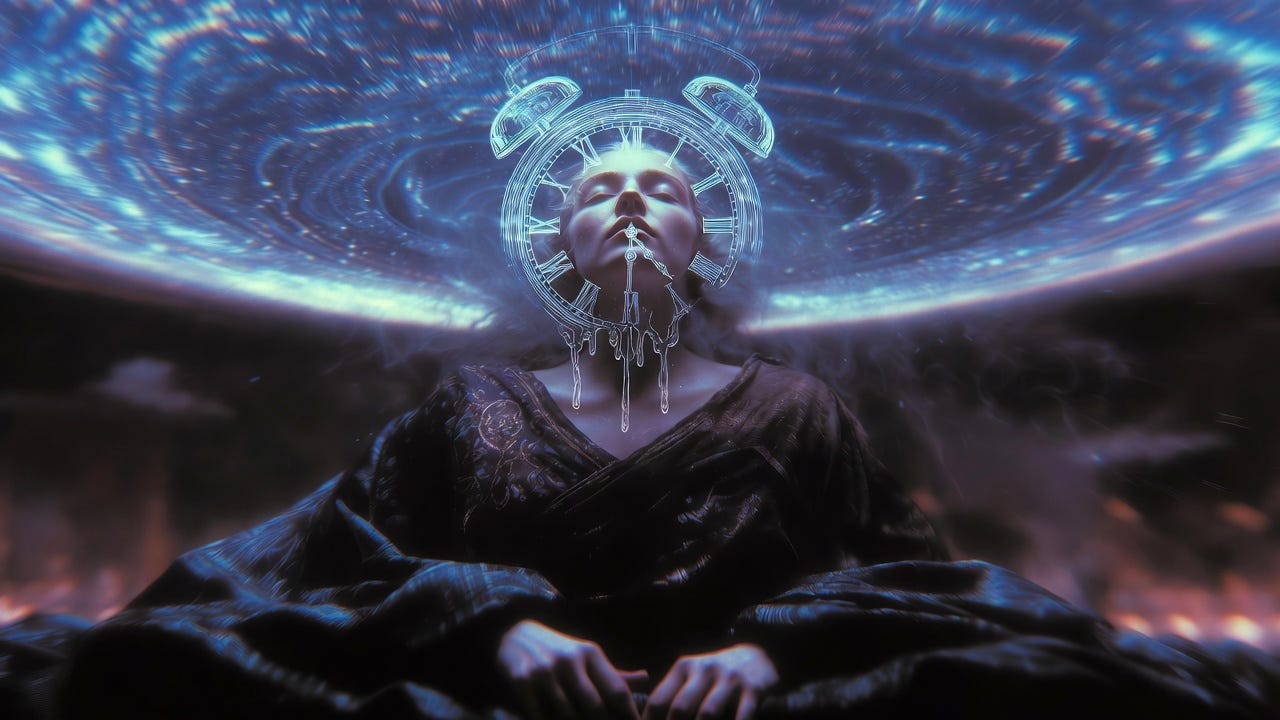
“Time keeps on slipping, slipping, slipping, into the future”
—The Steve Miller Band
The Stubborn Illusion of Now
There is a book entitled Changed in a Flash by Elizabeth Krohn and Jeffrey Kripal that recounts a powerful near-death experience which completely transformed Elizabeth’s life. In the aftermath of this profound event, she began having prophetic dreams. On July 17, 1996, she dreamed of a commercial jet crashing into the ocean. She saw “WA” on the wreckage, noted that there were 230 people on board, realized that no one survived, and identified it as flight number 800. On July 18, 1996, TWA Flight 800 crashed into the ocean, killing all 230 people on board.
Weird, no doubt. Many materialist scientists, academics, and skeptics would dismiss her account as anecdotal or methodologically unreliable. However, there may be another way for skeptics to consider such phenomena without abandoning their materialist perspective. Time itself is profoundly weird—there’s no escaping that. For many physicists and philosophers, it remains the last great mystery. We all experience its elusiveness: it stretches and contracts, betraying us when we’re enjoying ourselves and taunting us when we’re bored. Time races by when we want it to slow down and crawls when we want it to hurry up.
Since Einstein demonstrated that time is relative and dependent on factors we would never intuitively expect—such as our speed—we have had to confront realities we can’t simply ignore. Just how malleable is time? And do the past and future even exist in the ways we normally imagine?In a letter written after the death of his close friend Michele Besso, Einstein famously remarked, “For us convinced physicists, the distinction between past, present, and future is only a stubbornly persistent illusion.”
What?
It certainly feels as though the past is fixed and gone, while the future has not yet arrived. Our entire psychological lives are built on this assumption: memory looks backward, anticipation looks forward, and emotions like regret and hope depend on time moving in one direction. So what did Einstein mean?
He illustrated time’s relativity through thought experiments. One of the simplest involves two observers in relative motion: one standing on a train platform, the other riding on a high-speed train. Imagine lightning striking both ends of the train simultaneously from the platform observer’s perspective. Yet, according to the observer on the train, one strike occurs before the other. Crucially, there is no single, privileged “now” that both can agree on. What counts as past, present, or future depends on the observer’s frame of reference.The profound implication is this: if one observer’s present corresponds to another’s future, then those “future” events must already exist in spacetime. Otherwise, reality would depend on who is observing it—a notion relativity rejects. The future is not unreal or yet to be created; it simply exists elsewhere in the spacetime structure. Though we have not yet experienced it, it is ontologically real.
This perspective is known as the “block universe.” Here, time does not flow as it seems to us. Instead, we move through time much as we move through space. The future is not nonexistent; it is simply not where we are currently located in spacetime. Though counterintuitive, if this view is even approximately correct, it forces us to rethink a core assumption: that the future is fundamentally unknowable.
Once we entertain the possibility that the future “already” exists in some meaningful sense, we can ask whether seemingly impossible experiences—like precognition—might be natural consequences of how time actually works. Consider Elizabeth Krohn’s precognitive dream. Many of us have encountered subtler versions: a sudden certainty that someone will call just before the phone rings, or an inexplicable pull toward a decision that only makes sense later. These are so common we often dismiss them as coincidence.
Rather than rejecting precognition outright, perhaps we should reassess our instinctive skepticism and explore ways to integrate it into scientific understanding. In Einstein’s block universe, precognition follows naturally—which should offer some comfort to materialists. But physics isn’t the only field pointing in this direction. Neuroscience shows that the brain does not operate strictly in the present. Perception lags behind reality by tens or hundreds of milliseconds; what we experience as “now” is a reconstruction of the immediate past. Meanwhile, the brain constantly anticipates what comes next: it predicts sensory input, initiates motor actions before conscious awareness of the decision, and updates expectations accordingly.Consider a major-league baseball player hitting a 90-mph fastball. By the time the batter consciously perceives the ball’s trajectory, the swing decision has already been initiated based on an extrapolation of where the ball will be. The brain is already living in the (very near) future.
Whispers from Elsewhere in Spacetime

There is also evidence that the body anticipates future events. In experiments using physiological measures—skin conductance, heart rate, pupil dilation, and other autonomic responses—participants are exposed to randomly selected emotionally charged or neutral stimuli. Researchers record bodily activity while participants await the image. When data are later grouped by stimulus type, physiological responses differ before the image appears, depending on whether the upcoming stimulus is arousing or neutral. This “predictive anticipatory activity” (or presentiment) has been reported across multiple labs and hundreds of trials (Mossbridge et al., 2012; Mossbridge, 2014).
This raises an intriguing possibility: if the block universe is real, “prediction” may not be the right term. The brain and body may not be guessing the future so much as sampling it—albeit over a very narrow temporal window. The future is there to be perceived, but only to the extent our perceptual apparatus allows. Our perception functions like a temporal aperture, ordinarily tightly constrained to a thin slice of spacetime around the “present.” There is no obvious reason this aperture must remain so narrow forever. In certain cases—such as near-death experiences—it appears naturally expanded. In Einstein’s block universe, there should be no theoretical limit to how far into the block we might sample.
Widening the Aperture of Being
Such widening may also occur in deep meditative states. In the Yoga Sutras of Patanjali, one chapter discusses the “siddhis”—extraordinary abilities arising from meditation. By reducing the mind’s habitual distortions, including its rigid attachment to linear time, perception becomes less dominated by memory, expectation, and narrative. In this quiet, expansive state, different forms of knowledge can emerge, including awareness of events before they manifest in ordinary experience. Patanjali cautions against fixating on these abilities, instead encouraging us to see them as part of understanding our true, unlimited nature.
A paradigm shift seems underway in our understanding of reality—one that allows phenomena like precognition, telepathy, after-death communication, and out-of-body experiences (including those in near-death states) to be considered seriously. Even staunch skeptics might gradually release rigid beliefs about what can be known and recognize these capacities as natural consequences of spacetime’s structure. Since Einstein’s relativity, we have accepted that space and time are not what intuition suggests. Now, we may need to accept that a deeper grasp of relativity offers a plausible framework for what were once dismissed as “paranormal” phenomena.
Reality is likely far stranger than this account suggests, but rethinking time may be where that strangeness first becomes intelligible.
References: Mossbridge, J. A. (2014). Predicting the unpredictable: Critical analysis and practical implications of predictive anticipatory activity (PAA). Frontiers in Human Neuroscience.
Mossbridge, J., Tressoldi, P., & Utts, J. (2012). Predictive physiological anticipation preceding seemingly unpredictable stimuli: A meta-analysis. Frontiers in Psychology, 3:390.

All 50 States: A Passport to Your Mind: A new program for paid subscribers.
Each week, you’ll get a guided exploration of a single state of mind — from everyday states like focus, flow, and daydreaming, to deeper emotional, meditative, and contemplative states we all pass through in the course of a human life.
Think of it like a map + travel guide:
1. Clusters / Regions (like US regions):
Everyday States = “The Lowlands” (common terrain of life).
Emotional States = “The Heartlands.”
Meditative States = “The Mountains” (higher elevations of awareness).
Altered / Substance-Induced States = “The Islands.”
Mystical / Transpersonal States = “The Skies.”
Extreme / Edge States = “The Deserts & Depths.”
(If you’re already a paid subscriber and would like to receive the All 50 States email, click here).
