


Image: rtbf.be
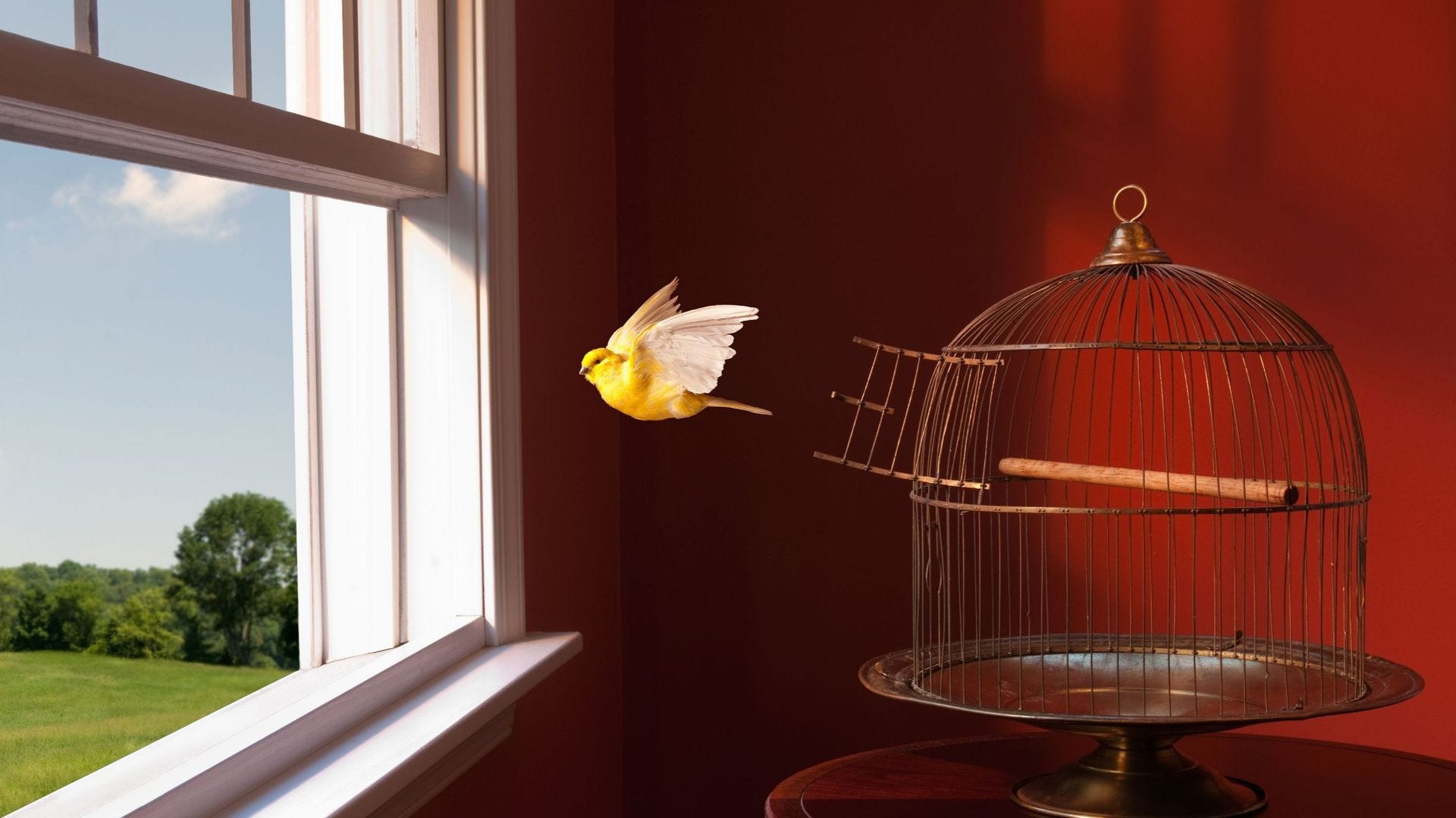
We asked some of our great writers for their thoughts on the inner meaning of freedom. Here’s what they said:
Freedom is, I think, both something that we humans always already have and also something that we ought to want to have. This sounds contradictory—why should we want something that we already have? The answer is that there are two senses of “freedom” at play here. On the one hand, we have freedom as a property of our constitution: being able to act, and not merely be acted upon, by virtue of our simply being alive. But we should also want to have freedom in the political sense: the ability to live a life with and amongst other people without oppressive and unjustified impediments.
—Lewis Coyne
The Dutch philosopher Johan Huizinga argues that play is freedom. In play, we leave the constraints and requirements of the real (or socially constructed) world—with its demands and challenges—and create our own, in which we make the rules, we set the goals, and we voluntarily step into a reality of our making. We might choose to play baseball, play house, or play with our food, but in doing so we escape the control that the outside world has over us, preferring an existence created by us. When Janis Joplin sang Kris Kristofferson’s lyric “Freedom is just another word for nothing left to lose,” the line expressed the freedom of someone abandoned by this world. Yet we can actively choose to step away from it on our own by choosing to play.
—Steven Gimbel
Freedom is a lightness, a release from the urgings of our temporal nature. It is the clarity of mind and heart that accompanies one whose intellect stands above emotion.
—Peter Himmelman
There is a classic psychological study by Richard Nisbett and Timothy Wilson in which subjects were asked to choose between identical pairs of pantyhose and, after choosing, confidently invented reasons for preferring the right-most pair. This study and others like it have shown that at the level of conscious understanding and egoic choice, we often lack genuine freedom. Much of what we call “choice” at this level is a post hoc narrative layered over unconscious, conditioned processes.
More recently, Robert Sapolsky has extensively argued for our lack of true choice in his book Determined: A Science of Life without Free Will. Drawing on neuroscience, endocrinology, genetics, and evolutionary biology, Sapolsky argues that human behavior is the inevitable outcome of prior causes operating far outside conscious control. In other words, we have no true freedom.It’s hard to argue against the ubiquity of ways in which conditioning and unconscious processes govern our behavior. But this does not exhaust the question of freedom.
There is a part of us that is capable of seeing that we may sometimes succumb to bias—a part that can choose to stand back and observe what the egoic conditioned self is up to. This part of ourselves is something spiritual and religious people have referred to as our higher self, the self-aware ground of being, or our soul.
This part of ourselves is the part that exists prior to any imprinting or conditioning, and is the part that can choose love over fear and meaning over randomness. While the human mind often expresses that freedom imperfectly through heavy constraints, we are capable of removing those constraints. What appears as a lack of freedom at the psychological level may thus coexist with a deeper, ontological freedom at the level of being itself. To live closer to that level of ourselves is to live closer to true freedom.
—Laleh Quinn
Jean-Paul Sartre famously proclaimed that we are condemned to freedom. In the late 1940s, after his falling out with his close friend Maurice Merleau-Ponty (arguably the greatest Western philosopher of the twentieth century) over issues including Stalinism, Merleau-Ponty offered a contrasting perspective: Because we are in the world, we are condemned to meaning. He may have been influenced by Viktor Frankl, though profound differences remain between their respective understandings of meaning.
The renowned psychiatrist and Auschwitz survivor Viktor Frankl wrote: “Everything can be taken from a person but one thing: the last of the human freedoms—to choose one’s attitude in any given set of circumstances, to choose one’s own way.”
This insight, however, does not begin with Frankl. We encounter it much earlier, in Genesis 3: “You are free to eat from any tree in the garden; but you must not eat from the tree that is in the middle of the garden, and you must not touch it” (NIV).
Adam and Eve are given a choice. They are free to make it, though not free from its consequences. Yet they remain free in another, deeper sense: they are always responsible for how they respond to the circumstances in which they find themselves. They choose to eat the fruit and encounter consequences they did not anticipate. Still, as Frankl later insists, responsibility does not vanish with suffering.
It is here, in the creation of our responses, that freedom resides. Regardless of circumstance, freedom is our capacity to shape how we respond. And it is in this act of creation that we are most fully autonomous.
—Stephen Stern
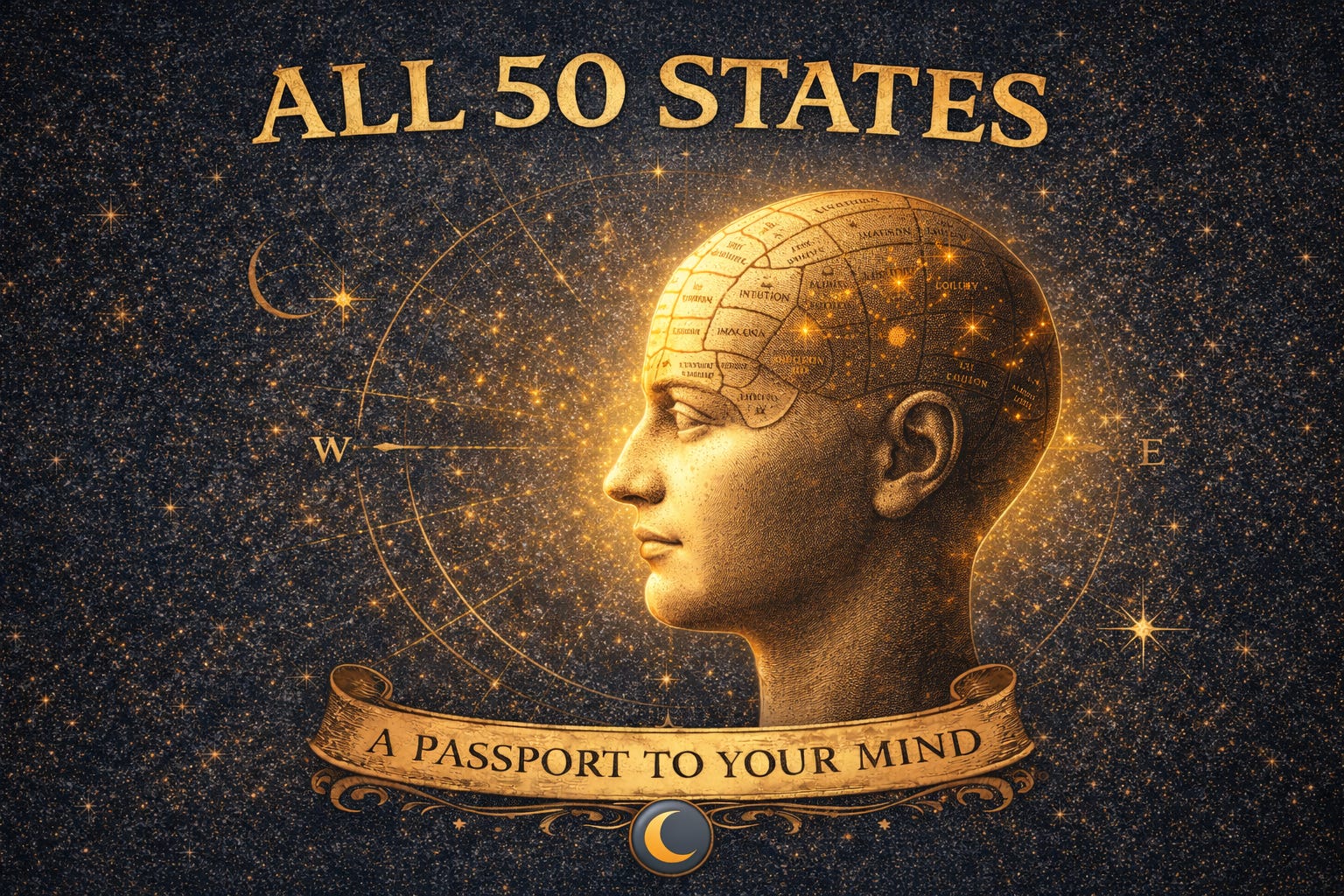
All 50 States: A Passport to Your Mind: A new program for paid subscribers.
Each week, you’ll get a guided exploration of a single state of mind — from everyday states like focus, flow, and daydreaming, to deeper emotional, meditative, and contemplative states we all pass through in the course of a human life.
Think of it like a map + travel guide:
1. Clusters / Regions (like US regions):
Everyday States = “The Lowlands” (common terrain of life).
Emotional States = “The Heartlands.”
Meditative States = “The Mountains” (higher elevations of awareness).
Altered / Substance-Induced States = “The Islands.”
Mystical / Transpersonal States = “The Skies.”
Extreme / Edge States = “The Deserts & Depths.”
(If you’re already a paid subscriber and would like to receive the All 50 States email, click here).


Well said, Peter! I like your words