


Image: moviemeter.nl
If you could experience a customized program that would reveal—and then force you to confront—your deepest, darkest challenge, would you?
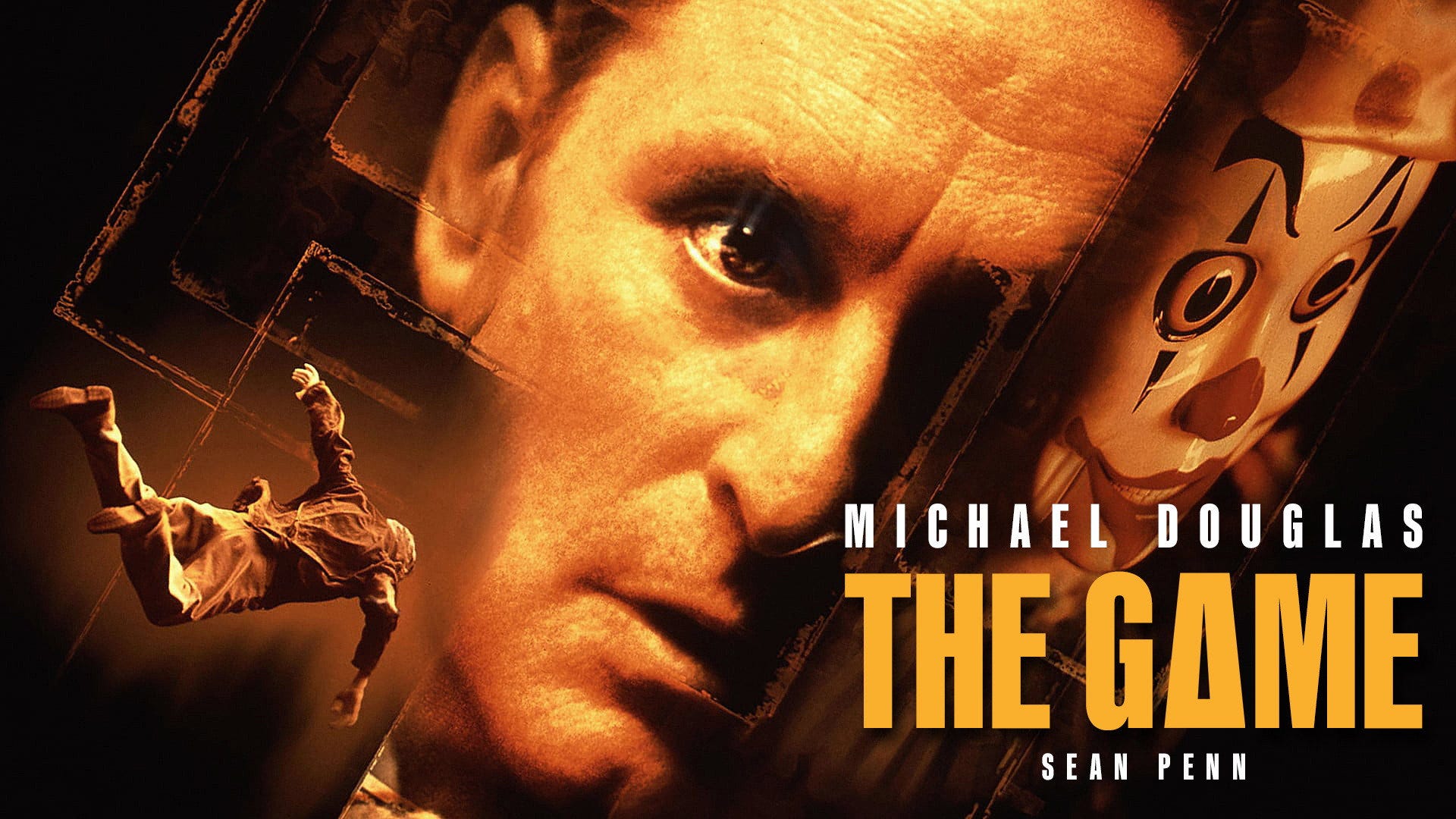
In 1997, hot off the success of Se7en, director David Fincher created the psychological thriller The Game. Starring Michael Douglas as Nicholas Van Orton—a cold, controlling San Francisco banker who lives a highly ordered but joyless life—and Sean Penn as his estranged brother, the film descends rapidly into a rabbit hole of mystery, confusion, and escalating chaos.
As it unfolds, we try to make sense of what is happening to this anti-hero. Is there a secret cabal behind it? Corporate manipulation and blackmail? Or is Nicholas simply losing his mind?
The final reveal reframes everything in such a striking way that I’ve found myself returning to it for years—not just as a twist ending, but as a metaphor for the human experience as I understand it.
You’ve probably been inside something you couldn’t make sense of. A relationship that dissolved without explanation. A run of setbacks that seemed almost designed to break you. An illness, a loss, a door that kept closing no matter how hard you pushed.
In those moments, you don’t philosophize. You panic. You grasp. You try to force the pieces into a shape you can live with.
But what if the incoherence isn’t the problem? What if it’s the point?
The Game suggests — and I find myself increasingly convinced — that chaos and meaning aren’t opposites. That what looks like randomness from the inside might look entirely different from somewhere else. Not random motion, but something more like orchestration. A structure you can’t yet see because you’re still inside it.
The Set-Up
Conrad Van Orton (Penn) gives his brother Nicholas a strange birthday gift: an invitation to a personalized experience from a company called Consumer Recreation Services (CRS). It arrives on Nicholas’s 48th birthday—the same age their father was when he died by suicide.
To enter “The Game,” Nicholas undergoes a series of physical and psychological evaluations. Then it begins. Or does it?
What starts as a curious diversion quickly becomes a sequence of escalating, reality-blurring events that seep into his personal and professional life, forcing him to question what is real, and who—if anyone—can be trusted.
One inexplicable event follows another, each one intensifying his fear and disorientation. Nicholas loses any stable sense of what is happening, who is involved, or even whether his own brother can be trusted.
By the climax, he finds himself on a rooftop—the same kind of place his father chose to end his life. He is holding a gun, convinced that the moment the door opens he will need to defend himself.
A woman beside him insists he is making a mistake. She tells him that on the other side of the door there are people waiting with cake and champagne, ready to shout “surprise.”
But Nicholas doesn’t believe her.
When the door opens, Nicholas fires.
In an instant, he becomes convinced that he has just killed his brother.
Standing there in a party hat, Conrad collapses backward as champagne glasses shatter around him. The “game” Nicholas believed he was surviving suddenly transforms into something far worse: the realization that, after all the paranoia, fear, and manipulation, he himself has become the instrument of irreversible tragedy.
The realization is unbearable.
Overcome by horror and convinced his life is now beyond repair, Nicholas stumbles toward the edge of the roof and jumps.
The Denouement (spoiler alert)
Image: www.themoviedb.org
The camera follows his long descent as he crashes through the glass roof of a pavilion below. But instead of striking concrete, he lands on a massive concealed airbag—like something used in a stunt performance.
He’s alive.
Moments later, Conrad appears beside him, very much alive, and calmly says:
“Happy birthday, Nicholas.”
The shadow of his father's death — the wound the whole game was designed to reach — has finally been touched, and survived. For the first time in decades, Nicholas is free.
Yes, this is a movie. Yes, the amount of planning, prediction, and risk involved would be nearly impossible to imagine in reality. That said, I increasingly suspect the film may point toward something real.
Imagine that life actually has meaning and that each event within it carries significance. This is not especially far-fetched if we allow for the possibility of an infinite creative intelligence — what some traditions call God, and others may simply call the source.
If that’s true, then perhaps what we experience as chaos is not randomness at all, but a form of orchestration we are simply unable to perceive from within the moment itself.
Like Nicholas Van Orton, we are often trapped in a loop of unknowing—a frustrating inability to pull back the curtain and glimpse the machinery of meaning operating beneath our lives.
For a rare few, some major event may eventually crystallize years of confusion into a coherent whole. But even for those who never receive that kind of clarity in this life, it is still possible that our struggles, losses, delays, humiliations, heartbreaks, and fears are not arbitrary. That they may, in some mysterious way, be structured toward growth, healing, or rectification.
Maybe clarity is not something we are given during the game.
Maybe it only arrives once we’ve passed through it.
Q: Have you ever been so deep inside something that it felt like pure chaos — only to look back later and see exactly why it had to happen that way?
Yes, absolutely YES! I have 3 sisters--2 older and 1 younger (by 11 years!). All of them found what they thought was love and all of them married. I remained single. I did have affairs (not many) but nothing lasting. I was so sad. Then I met the love of my life and we married. We have been married for 40+ years. We still love each other. Meanwhile, all of my sisters had gotten divorced. One had a second husband who was another creep; he died. One is still single. And the youngest married a second husband and they are still in love. I truly believe that I was meant for better things although I had to wait for them. I had to be mature enough to realize this. And he had to be ready too. Yes, G-d had a plan!