


Image: J.D. Salinger, larazon.es
People speak with me from time to time—musicians, writers, CEOs, people who, since childhood, have never drawn a single line on a piece of paper but feel an ache somewhere inside them—and they want to know how to start. They think creativity is a kind of machinery: you plug in an idea, crank the handle, and something worthwhile pops out the other side.
What happens next? The machine doesn’t work for them. They remain convinced that it only works for people who possess the skills to press the right buttons.
But what I’ve learned, after a lifetime of writing songs, painting, telling stories, scoring films, and teaching thousands of people how to access their creative mind, is that most people begin at the wrong end of the process. They believe they need a clear idea before they take a step. The idea becomes a prerequisite, a password, a key they think they must possess before the door will open.
And this is where the trouble begins.
People in their rooms, at their desks, in front of their blank pages, trying to think their way into the right idea. They strain for it. They pace. They wait for lightning. And all the while they’re tightening the screws on their own brain, turning what should be an open window into a locked door. The pressure becomes unbearable. Negative assumptions stack up: I’m not ready. I’m not good enough. I’m not creative.
They’ll wait until they feel certain. Meanwhile—nothing.
Starting from Nothing: Why the Blank Page Is Your Greatest Ally
But here’s the secret: nothing is exactly where you’re supposed to start.
Most creative people I know, whether they are songwriters, choreographers, jazz drummers, or corporate innovators, are completely comfortable not knowing what they’re doing. They don’t fear the blankness. They don’t demand clarity before they begin. In fact, they know that the absence of an idea is not a barrier; it is a propellant.
Creativity, as I understand it and teach it, is not the manufacturing of something. Not the application of clever techniques. Not the construction of a finished product. Those are innovations. And innovations are wonderful, but they come later.
Creativity is first and foremost a state of mind.
A way of being.
A loosening.
And that state is unconcerned with judgment, especially self-judgment.
People think great painters sit down with a fully formed image in their heads, that great songwriters know what they’re writing about before they touch the guitar, that great novelists see the entire plot the way a driver sees the road ahead. But most of the people I’ve known who make good work—really good work—often start in complete darkness. They sit down at the piano with open minds. They pick up a paintbrush without a subject. They step onto a stage not knowing what the first word out of their mouth will be.
What they do have is willingness.
A desire, vague but powerful.
An intense curiosity about what might occur.
Let me give you an example from songwriting, since that’s been my lifelong doorway into the mystery. You might sit down with a guitar. You strum a few chords. They don’t mean anything yet. They’re simply sounds in the air. Then maybe you look outside and see a hummingbird flashing through the birdbath. That tiny motion calls up something else—maybe a time in childhood when you felt hurried, nervous, thrilled for reasons you didn’t understand. Maybe you remember a kitchen, a certain smell, your father’s tennis shoes, a slammed door, a summer evening when you kissed a girl for the first time.
You don’t force these memories. They emerge on their own, as if rising from the bottom of a pond. And here’s the crucial part: you write before you know what you’re writing about.
The meaning reveals itself only after you’ve begun.
I can tell you that my best songs didn’t come from me “waiting for the idea.” They came from me stepping into the unknown with a sense of curiosity. I wrote into understanding, not from understanding. I met the song the way you meet a stranger—you learn who they are through the encounter, not through your assumptions.
Honestly, that’s how everything worth doing works.
It mirrors the very structure of creation itself.
The Courage to Be Lost: How Indeterminacy Unlocks Originality
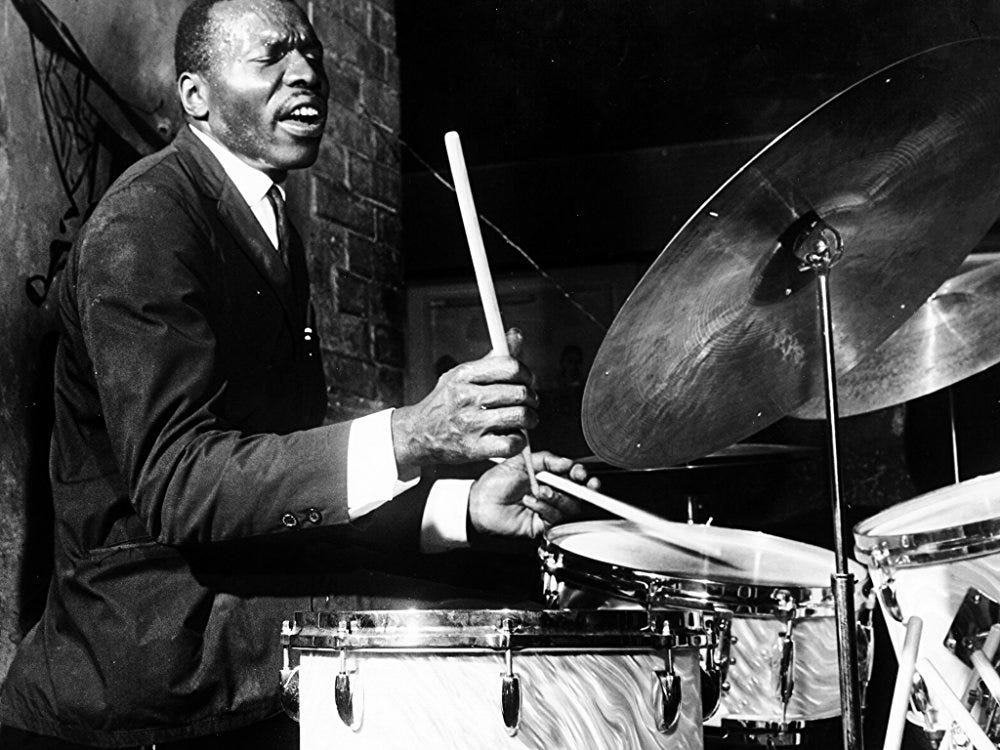
Image: Elvin Jones, cruiseshipdrummer.com
Now, I’m not asking you to believe the Biblical creation story as literal fact. You don’t need to. What’s important is the archetype embedded in that story: the movement from nothingness to somethingness. The emergence of form from a void so pure that even the word “void” fails to describe it. We think of “nothing” as the cold dark of space, but space is something. It has properties, texture, and depth. True nothingness is impossible for the human mind to conceptualize. And yet, out of that impossible nothing, comes the world.
Creativity works the same way.
You begin with nothing—nothing you can name, nothing you can hold. And from that nothing arises the first flicker of something: an opening line. A sentence. A brushstroke. A shape in the back of your mind that you didn’t invite and don’t fully understand. And if you can quiet the voice that insists on order before play, you will discover the beginnings of your work.
I once watched a well-known drummer figure out a groove by closing his eyes and simply breathing. His foot tapped once, twice. He took a pair of mallets and, barely touching them to a ride cymbal, began creating a rhythm for one of my songs—one I had never envisioned. We smiled at each other. My song took on a completely new pulse, a better way to frame the harmony and the lyrics. The music had summoned his drum part. It became part of the DNA of the entire song.
Think about that: DNA is a form created from almost nothing—microscopic, invisible, and yet holding unfathomable complexity. Your creative work is built the same way.
Now, let me address something important.
When people say they are “not creative,” what they usually mean is that they are uncomfortable with this state of indeterminacy. They don’t like the feeling of being lost. They think being lost is a sign of weakness, of incompetence, of amateurism. But being lost is exactly where creative people live. It is the price of admission—the environment where the imagination flourishes.
I want you to imagine meeting someone for the first time. Before you sit down with them—before you hear their voice or observe the way they hold their coffee cup or notice that tiny crease between their eyebrows—you might have assumptions. But you don’t really know them until you meet them, until you open your mouth and they open theirs. Creativity is like that. You sit down with it as you would with a stranger. With kindness, with patience, you allow it to reveal itself. You don’t demand full disclosure before the first hello.
Writing into the Dark: Discovering the Work by Beginning It
Some of the most powerful creative practices I’ve seen are deceptively simple. Here are three of them:
Sit There. Do Nothing.
You sit down at the instrument or the page not with an idea, but with a desire to be there. You take a breath. You listen. You let your mind move like clouds across a landscape.
Take One Step.
You simply write one sentence, then another, then another, without asking what they mean. Eventually, meaning emerges as naturally as a photograph developing in a tray of chemicals.
Set a Timer.
This has been one of my most useful tools. I set my iPhone timer for seven minutes. I’m in that state of “nothing,” and I work for at least that amount of time. I’ve found it’s enough time for an idea to get aloft—like a plane gathering speed on the runway and lurching skyward. Seven minutes is enough time for an idea to flicker. It’s also short enough that you can handle the probability of not finding anything.
And if nothing comes? Good! You are learning to tolerate nothingness. You are strengthening the part of yourself that can step into the dark without freezing.
You may worry that this approach is inefficient, or childish, or indulgent. But I promise you: all great creative work carries within it the fingerprints of someone who was willing to be lost. That lostness becomes the source of originality. It prevents you from repeating yourself, from regurgitating clichés, from clinging to the same tired images you’ve used a hundred times before.
Let me give you another image. Think of a seed. A tiny, unremarkable thing, easily overlooked or brushed aside by a squirrel’s tail. Inside that seed is the entire blueprint of a tree. But the seed is not the tree. It doesn’t resemble the tree. It doesn’t explain the tree. The seed is simply the smallest beginning, the quietest possible “yes.” Creativity begins with a similar yes—a yes so small it barely registers. A sound. A memory. A hint of a feeling you can’t yet name. But if you stay with it, if you keep showing up, the seed becomes something astonishing.
We tend to romanticize the moment when a song or a painting or a poem is finished, but the sacred moment is the beginning—the moment when nothing turns into something. When chaos begins to shimmer into form. When the unknown becomes ever-so-slightly known.
So, if you’re struggling, know this:
You’re struggling not because you lack talent or insight or imagination. You’re struggling because you’ve been taught the wrong way to begin. You’ve been told you need certainty, and certainty is the one thing that creativity does not require. What it requires is willingness, humility, presence, and a genuine desire to discover something you didn’t know before.
If you can learn to tolerate not knowing, if you can sit in that early darkness without panic, everything opens. The ideas will come. They always do. Maybe not when you want them to, maybe not in the form you expect, but they will come.
Think of creativity as the friend standing outside your door, waiting for you to unlatch the lock.
And when it finally enters your life, when the something emerges from the nothing, you may be astonished to discover that it was not an idea you were waiting for.
It was someone you only thought you knew.
Yourself.

Peter hits the nail on the head once again! Thank you for having him!
It's in the bardo/in the air/in the sky/why? Wherever it may be, it is a joy to grasp it. You are a true mystic. I relate because a lot of my own things come from the bardo.