



Is the flow of time something real, or might our sense of time passing be just an illusion that hides the fact that what is real is only a vast collection of moments?
—Lee Smolin
I’m sitting in my kitchen as I type this, working on a bowl of yogurt between sentences and thinking my strange thoughts, asking myself a strange question:
Is this large wooden saltshaker on the Lazy Susan in front of me—an odd term that inevitably makes me think of my deceased sister Susie, who as an adult preferred to call herself Susan—more real than my fond and tearful memories of her?
Susie died in the early 2000s in a terrible car accident while driving home from visitor’s day at her eldest daughter’s summer camp. It was the kind of phone call that cleaves a life in two, dividing time into a before and an after. Even now, many years later, the memory of her arrives unannounced, as vivid as lightning: a fragment of a laugh, the brightness of her smile, the way she’d never say a bad word about anyone. Sometimes I reach for my phone to call her and instantly realize I’ve forgotten her number—not that I could reach her with it anyway.
But let’s return to the question. Is the saltshaker more real than my memories of Susie?
What if, in an odd and cruel hypothetical, I were forced to decide?
Here’s the setup.
A giant blade swings from the ceiling, Pit and the Pendulum style. Whoosh. Whoosh.
A booming voice, soaked in reverb, asks the question again: “Which is more real? The saltshaker? Or your memories of Susie?”
Answer correctly and I go free. Answer incorrectly and I suffer a gruesome death.
Which would I choose?
The very real saltshaker?
Or the vague notion of Susie, who no longer occupies physical space in this world?
My answer is that the memories of Susie are more real to me than the saltshaker.
Why?
First, I’d be suspicious. Tests like this rarely reward the obvious answer, which for most people would be the saltshaker: a physical object, solid, weighable, photographable—Exhibit A in any courtroom.
But the second reason matters far more. It’s unlikely that I’d think about the saltshaker several times a day, as I do Susie. The saltshaker doesn’t visit me. Susie does. Sometimes it’s the sound of her voice. Sometimes it’s the way I always felt understood in her presence. Sometimes it’s a fleeting fragment of an ordinary moment that suddenly rises in my mind with surprising force.
Real love. Real loss. Real joy. Real sorrow.
Even with the blade swinging overhead—whoosh whoosh—the memories of Susie would win out because of their emotional heft. They are not rock. They are not measurable matter. But in terms of intensity they are rock-like. They possess a density of meaning that a saltshaker cannot approach.
In this sense, they are more real than the things I was acculturated to think of as real.
Now this may sound sentimental, or perhaps even irrational, but modern physics has already complicated our tidy assumptions about reality. Carlo Rovelli, one of the leading thinkers in theoretical physics, has suggested that what we call reality may not consist of solid objects at all but of relationships between events. In his relational view of quantum mechanics, things do not simply exist on their own. They exist in relation to something else that observes or interacts with them.
A saltshaker sitting quietly on a table may seem self-evidently real. But physics now tells us that its solidity is largely an illusion created by electromagnetic forces and probabilities. At the most fundamental level it is a restless cloud of particles and fields, none of which possesses the comforting stability our senses report. The atoms inside it are mostly empty space, structured by forces we cannot see. The idea that the saltshaker is a simple, self-contained object begins to look less certain the deeper we examine it.
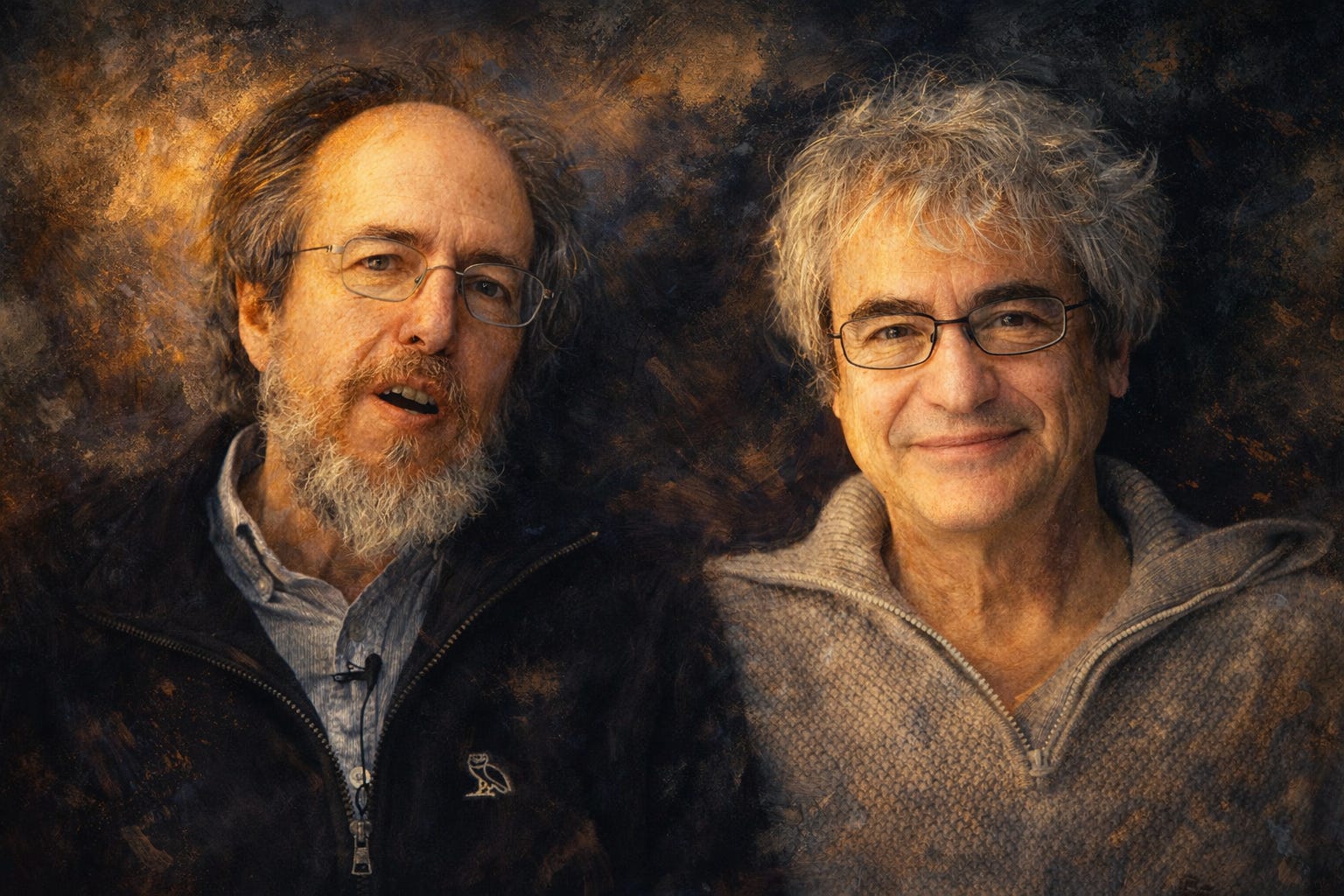
Image: Lee Smolin and Carlo Rovelli
Lee Smolin, another prominent physicist, has argued that time itself is real and that the universe is not a static structure but an unfolding process. Reality is not a frozen block but an ongoing sequence of moments in which new events come into existence and then vanish into the past.
If Smolin is right, the past does not simply disappear. It becomes part of the structure of the world. Events that once occurred remain woven into the fabric of reality, shaping everything that follows.
Which means that Susie’s laughter, Susie’s voice, Susie’s presence in the life of her children and mine were once genuine events in the unfolding of the universe. They happened. They left traces. They altered the trajectory of countless later moments, including this one.
Physics often speaks about conservation laws. Energy is not destroyed; it changes form. Information, some physicists argue, may never truly disappear either. The universe keeps a record, though not necessarily in ways we can easily access.
The saltshaker may occupy a small region of space on the Lazy Susan. But the events that constituted Susie’s life ripple outward across time.
And the mind—that peculiar instrument inside our skulls—has the ability to revisit those events. Not perfectly, not with laboratory precision, but with an emotional clarity that can be astonishing. The memory does not simply represent the past. It partially reactivates it. Something of the original experience flickers again into existence.
Neuroscientists tell us that remembering is not like opening a file cabinet. Each time a memory returns, it is reconstructed. The brain assembles fragments of sensation, emotion, and narrative into a living moment. In that sense the past is not entirely past. It is continuously renegotiated in the present.
Which leads to a disconcerting possibility:
Perhaps reality is not limited to objects that sit quietly in front of us. Perhaps it also includes the network of past events that continue to exert influence on the present.
Consider how often we live inside those invisible structures. A smell in a kitchen returns us instantly to childhood. A few notes of a song summon a room that vanished decades ago. A face glimpsed in a crowd briefly resurrects someone we loved who is no longer here.
These experiences are not hallucinations. They are interactions with a layer of reality that is difficult to measure but impossible to deny.
If the saltshaker vanished tomorrow, I would notice briefly. I might even look for it around the table. Within minutes the matter would be forgotten.
But if my memories of Susie vanished tomorrow, something much larger would disappear. A portion of the architecture of my life would collapse. The story that brought me to this moment would lose one of its central characters.
Every conversation we ever had. Every shared joke. Every argument and reconciliation. All of it would vanish like a library burned to the ground.
So which is more real?
The saltshaker, which occupies a few cubic inches of space?
Or the memory of a person whose existence continues to shape my inner life decades after her death?
I never said the saltshaker is not real. Of course it is. But the memories of Susie are more real. They carry more weight in the unfolding of time, more consequence in the structure of my life, more energy in the field of consciousness.
And if the physicists are even partially correct, that distinction may not be as absurd as it first appears. Reality may not be made only of things. It may be made of events, relationships, and the strange persistence of moments that refuse to disappear.
Perhaps what we call the present is only the narrow beam of a flashlight sweeping across a much larger landscape of time. Most of the terrain lies in darkness, but it does not cease to exist simply because the light has moved on.
In quiet moments I sometimes imagine that the past is still there—not as a ghostly fantasy but as a completed region of the universe. Somewhere within that vast tapestry, Susie is still laughing, still walking across a room, still saying something that causes the rest of us to burst out laughing.
If that sounds improbable, consider that much of modern physics already tells us that the universe is stranger than our everyday intuitions allow.
In any case, even if the blade were to one day swing again…
Whoosh. Whoosh.
And the booming voice were waiting for my answer…
My answer remains the same.

Brilliantly stated and expressed. There is a basic distinction between the ‘real’ and the ‘actual’. The real is relational and ‘hidden’ beneath the surface of the ‘interface’ we have evolved to maximize the likelihood of our temporarily physically embodied existence. So what we perceive as actual is a ‘construction’ based on our sensations in the moment put together by our human species-specific evolved interface with what is ‘outside’ of us. It hides the relational reality the way what is on the screen of the computer hides what is really going on in the precisely controlled flow of electrons in its hardware. It is useful to make a distinction between the ‘actuality’ that is constructed for us and the relational reality that is hidden beneath which is not sensed but can be felt emotionally. This is the work of cognitive neuroscientist, Donald Hoffman. It ultimately comes down to a distinction between this hidden continual flow of time and the discontinuity necessarily built into what we perceive as ‘actual’. And the work of Iain McGilchrist suggests that we have one hemisphere—the left usually—that constructs this discontinuous ‘actuality’, what the other—typically the right—connects to the continually unfolding hidden relational reality that arises in the ‘quantum substratum’ that is hidden us but which is accessible emotionally. So there is a fundamental difference between the ‘explicate’ actuality on the surface and the underlying ‘implicate’ reality hidden beneath. Suggest checking out the ‘relativistic Transactional Interpretation of Quantum Physics’ developed by Ruth E Kastner at transactionalinterpretation.org .
Her books for the lay public that describe the principles of the physics are really helpful.
Thank you for this. Great concepts.👍