


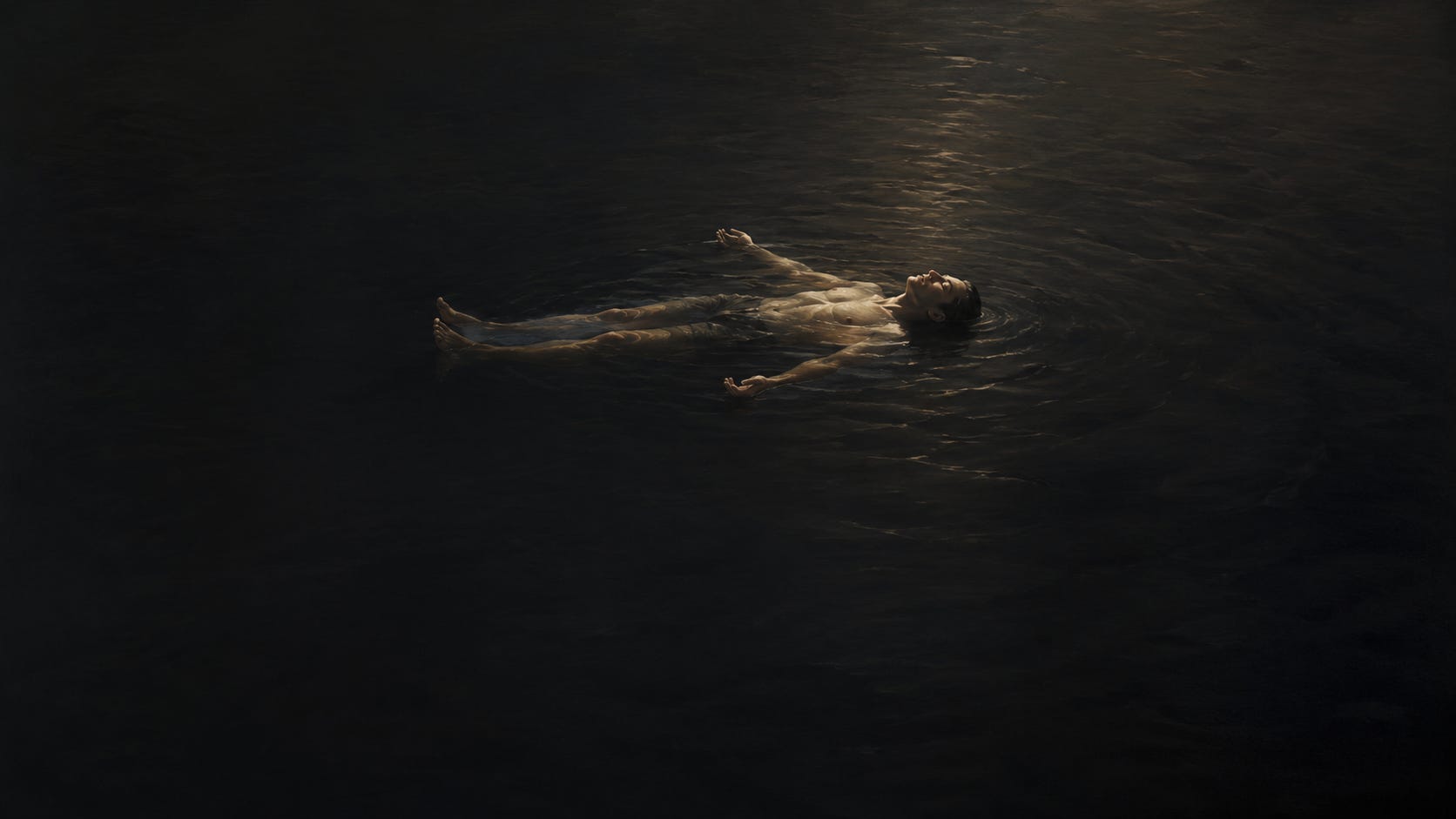
Even though I was completely alone, I admit I felt both embarrassed and a little nervous. I was disrobed and spread-eagle, floating in ten inches of water so saturated with Epsom salt that sinking was impossible. It was pitch black. I’d been in the tank all of five minutes out of my allotted sixty, and I was already wondering if this had been a good idea.
I'd gone in on principle. If I was going to write and teach about states of mind, it seemed only fair to actually visit a few of them — and the float tank offers one you can't reach any other way. It's a chamber engineered to subtract: no light, no sound, and water set so precisely at skin temperature that you lose track of where your body stops and the water begins. Strip away everything the senses normally deliver, and you find out what's left when there's nothing left to notice.
Which is a stranger project than it sounds. Because sometimes the only way to gain something is by giving away everything else. We know this instinctively in states of deep focus — the kind that only works when we block the rest of the world out. Choose a life partner and you quietly exclude every other one you might have had (hopefully). We would all love to hold everything at once, but the fact remains: the more you grasp of one thing, the less you have of another.
And what the tank proposes is bolder than just a trade-off. It suggests that subtraction isn’t only a cost — it’s a method. That taking things away is how you find what was actually there.
There was a well-known Frenchman who took a similar approach to discovering what, if anything, could be known for certain. René Descartes subjected all of his knowledge to a single test: if a piece of it could possibly be the product of delusion or misperception, he discarded it. Information from the senses went first, since the senses are so easily fooled — a straight stick looks bent in water. He questioned the external world itself, since for all he knew he was only dreaming it. Even the seemingly bulletproof arena of mathematics fell, since it was conceivable that a malin génie — an evil demon — had tricked him into believing things that weren’t so.
And then he arrived at his famous breakthrough. Even if he were wrong about everything — even if every perception were a deception — something still remained. There had to be someone being deceived. Even if all that existed was doubt, there was still the one who doubts. Doubting is not something nothing can do; the very act of trying to subtract himself proved there was a self doing the subtracting. Cogito, ergo sum — I think, therefore I am.
What I experienced in the tank was, I think, something similar. I didn’t have an out-of-body experience, see my past lives, or anything quite so dramatic. What happened was quieter than that. With the outside world suspended, something rushed in to fill the vacuum: the mind itself. Freed of anything to react to, it churned — memories, plans, the drift toward a halfway, hypnagogic sleep.
But if you stay with it, you begin to notice something underneath the churning. Not another thought — the thing that is aware of the thoughts. The one watching the mind work. This is sometimes called the witness: the awareness that observes your thoughts and feelings without being identical to them. It turns out that what Descartes reached by pure contemplation, you can arrive at by experience — the same irreducible observer, found not by argument but by subtraction.
Descartes was far from alone in this realization, and far from the first to have it. This fundamental awareness has been explored by cultures around the globe since time immemorial. The Hindu approach is neti, neti — “not this, not this.” It’s a method by which the practitioner uncovers his true self by negating everything that is not it: the body, the senses, the thoughts, the emotions. When all of it has been stripped away, what remains is the awareness that cannot be negated.
Christian mysticism arrived at a parallel method, the via negativa, whose exponents include Meister Eckhart. The idea is that you describe God not by what He is but by what He is not — because every conceivable positive statement is ultimately inadequate, unable to contain the true nature of the Infinite. By removing every inadequate concept, one after another, we may paradoxically arrive at something truer than any concept could hold.
The instruments could hardly be more different — a French rationalist’s chain of doubt, a Hindu sage’s contemplative negation, a Christian mystic’s unsaying of God, a meditator’s disciplined stillness, and my own hour in a tank of salt water. But they all make the same move, and they all end in the same place: strip away the inessential, and what remains is the one thing that was there all along.
So what is that thing all these inner explorers have been striving to reveal? Why have so many mystics, saints, and seekers spent their lives plumbing the hidden recesses of their own being? Because they see that layer of awareness as the gateway to all the rest — to deeper connection with themselves, with other people, with the transcendent, and ultimately with God. It struck me, floating in the salty dark, that the tank is a kind of womb: warm, buoyant, holding you weightless while it births you into a fuller awareness of who was already there. You don’t need the tank, of course. That awareness is beneath the noise of any ordinary day. The tank only makes it harder to ignore.

If this is the sort of thing you like thinking about, compassion is one of fifty states of consciousness I mapped in All 50 States: A Passport to Your Mind — a guided journey through the full terrain of the inner life, from ordinary waking awareness to grief, flow, awe, mystical union, and the harder territories most of us visit without a map. Each state comes with its own orientation, its own wisdom from across the traditions, and its own practice. All fifty lessons are available as a single download.
Coming this fall: I’ll be leading a small founding cohort through the first segment of the map — five weekly lessons and a live session together, beginning Sunday, Oct 18.
So ... did you have an in-body reaction to what 'remained?'
And were you at all surprised at whatever revelation presented?
Would you perhaps do it again?
Is 100 times ever enough, once you get the hang of plumbing your mind?
And was your skin irretrievably puckered for many a day?
I AM THAT I AM ... does it for me, if mandated to choose another word for the Infinite, Gd, which also does it for me.
Oh how I wish writers of the spiritual realm would find another word for God/Source/The Absolute All That Is than "He, His, Himself."