


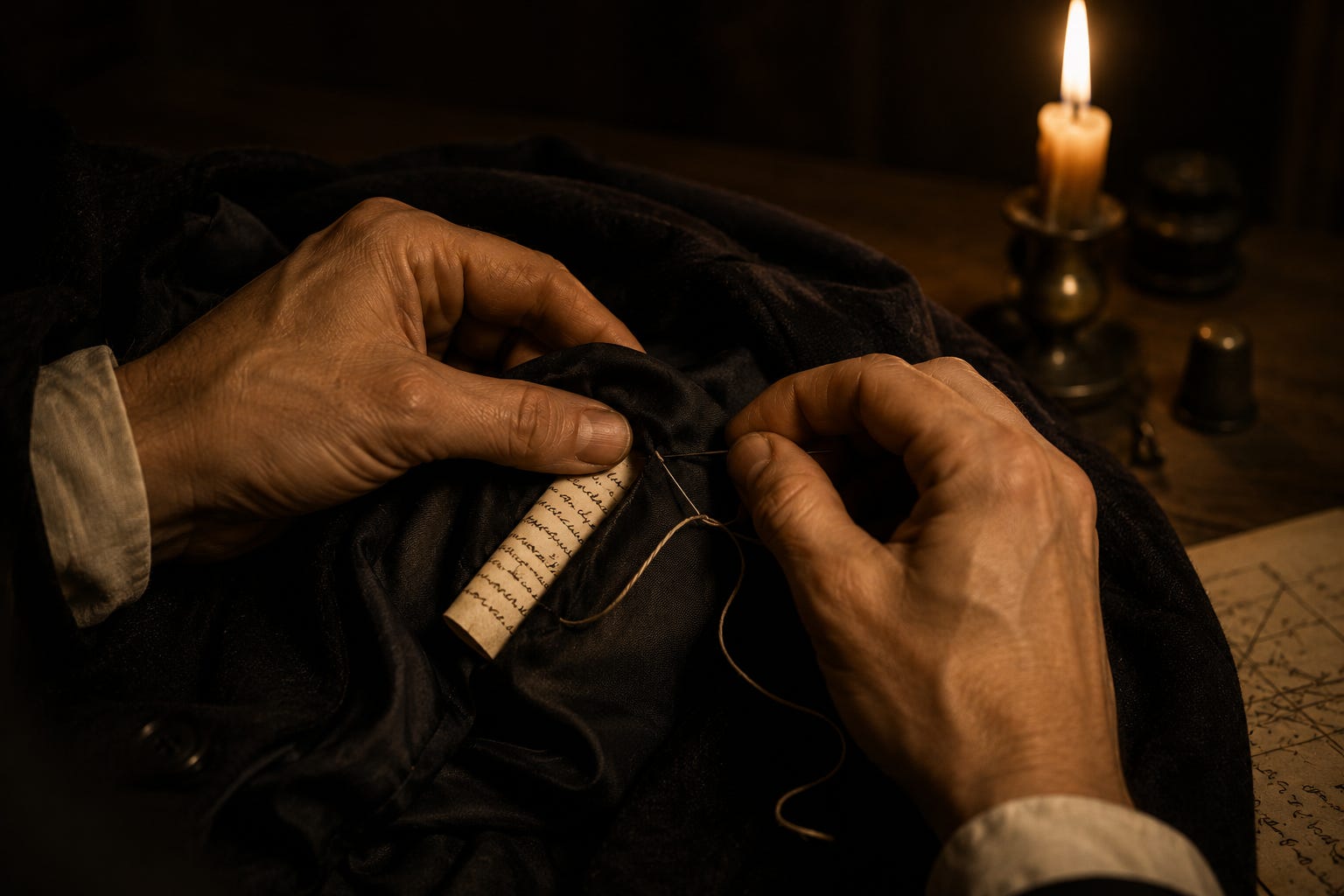
A few days after Blaise Pascal died in 1662, a servant noticed something odd about the great man’s coat: a thickness in the lining, where there shouldn’t have been one…
On the night of November 23, 1654, from about half past ten until half past midnight, the French scientist had experienced a two-hour mystical vision he would later call his “Night of Fire.” Though he was already a celebrated mathematician, physicist, and inventor — and already a man of some faith — the experience remade him. From that point on he largely abandoned science and worldly affairs, devoting himself to religious writing, most famously his Pensées. He embraced an ascetic life, sold his finest possessions and gave the money to the poor, and held to his faith until his death, at the age of 39.
That night, he had immediately written the experience down on a small piece of parchment he called his “Memorial.” Then, oddly, he sewed it into the lining of his coat — and for the next eight years, each time he had a new coat made, he carefully cut the parchment out and sewed it into the new one, so that it was always with him. No one ever knew. The document came to light only by accident, after his death.
The Memorial is a passionate mix of prose, prayer, biblical allusion, and ecstatic exclamation, mostly in French with phrases of Latin. It reads, in part:
FIRE. God of Abraham, God of Isaac, God of Jacob — not of the philosophers and the learned. Certitude. Certitude. Feeling. Joy. Peace.
Why would a man sew that into the lining of his coat, and carry it there in secret for the rest of his life?
Move forward three hundred years, and into the world of fiction, and you find a man cut from the very same cloth. In Paul Thomas Anderson’s film Phantom Thread, the idiosyncratic dressmaker Reynolds Woodcock — brilliantly played by Daniel Day-Lewis — has a habit of sewing hidden things into his garments. But whereas Pascal sewed out of spiritual ecstasy, Woodcock sews out of grief. The death of his mother had marked him deeply; in a fevered vision of her during an illness, he murmurs, “I miss you… it’s as simple as that.” His way of keeping her close was to sew a lock of her hair into the lining of his own coat, and carry her there, always.
Two men. One gesture.
Open almost anyone’s closet and you’ll find the same thing in a plainer form: a shirt you don’t wear but can’t give away, a dress kept only because of the day it was worn, a coat that still smells like someone. Next to the body itself, the garment is the closest layer we have to a person, and the clothes we choose serve, on some level, to communicate something concealed inside us. They are costumes that evolve with the times; a signal that you belong to this group or that, an index of your tastes and temperament. But, as George Michael once sang, “sometimes the clothes do not make the man.” There is a sense in which our garments blunt and conceal our true selves.
So a garment does two things at once. It conceals us — obscures, masks, holds the world at a slight distance. And it connects us — carries what is most private right at the surface, where it can be near other people without being seen. Pascal and Woodcock only made literal what the rest of us do without noticing. We are all sewing something precious into the lining.
Which raises a stranger question. If the clothing closest to us can carry what we cannot say — what about the garment closer still?
There is a Kabbalistic reading that treats the physical body itself as a garment. It turns on a single letter. In the account of Eden, after the fruit is eaten, God clothes Adam and Eve in ohr — “skin” — spelled with the Hebrew letter ayin. But there is an old tradition that the word was once written differently: ohr with an aleph, the same sound but a different word, meaning not skin but light. Read that way, the verse remembers something — that the first human garment was not skin but radiance, a body that let light shine through it, and that “skin” is the denser thing it became.
Seen this way, the body is a kind of filter with an adjustable opacity. The more refined we become, the more that inner light is allowed to show through. The body is, at once, a barrier and a means of connection. Like a kettle, which keeps water and fire apart so they don’t destroy each other and, by that very separation, lets the fire pass its heat into the water, the body holds the soul and the world apart so that they can meet at all. The garment is the interface. It conceals, and by concealing, it connects.
How much of your true self are you willing to reveal? Many people don’t even share their deepest parts with themselves, let alone others. There’s something in there that’s absolutely personal — something that doesn’t feel like it’s for public consumption. So we filter. We let dribs and drabs of our consciousness escape the garment of the body and test what effect they have. Will it be embraced, valued, reciprocated? Or laughed at, criticized, and ignored — until the aperture of the soul constricts again?
There is something in human nature that wants to share. It’s the impetus for everything from Faust to Facebook. But some things — for some people, whether ecstatic rapture or the despair of unresolved grief — can only be “worn on the sleeve” if that sleeve never faces outward.
Pascal never showed anyone his. For eight years he carried the most important night of his life sewn into his coat, moved it from old coat to new, and let no one read a word of it. It wasn’t for them. It was the thing he needed against him — proof, on the days he doubted, that the Fire had been real.
But a lining is not a grave. What we sew away in secret, we sew away to keep — and what we keep, we sometimes find the courage to let show. The point of a garment of light was never to trap the light. It was to wear it. Maybe the things we carry closest are not meant to stay hidden forever, only until we are ready — until the day the seam is opened, and what was pressed against the skin turns out to be the brightest thing we own.
Q: If you sewed one sentence into the lining of your coat, to carry against you for the rest of your life — what would it say?
"I care about this because my faith teaches me that salvation has to do with how I make myself useful to those who have been excluded, marginalized, and cast aside and oppressed in society."--Pete Buttigieg
This quote by Pete gave me a frisson when I first read it. I decided right then and there I would want it on my tombstone because it is all about how my life is lived, what animates me to exist.