


Politics, as a practice, whatever its professions, had always been the systematic organization of hatreds.
—Henry Adams
I favor politics as practical morality, as service to the truth, as essentially human and humanly measured care for our fellow humans.
—Vaclav Havel
Politics is a confusing thing. On the one hand it seems to be one of the few ways for people to successfully address issues of great import to them and contribute to shaping society into something resembling the place they would most like it to be. Fine and good. On the other hand, given that there are others in our society who want the inverse of what you may hold dear and envision a place quite unlike the one you do, an ongoing friction is guaranteed. This friction produces heat and the thing about heat is that sometimes it’s manageable and sometimes it’s not.
Despite being descended from two American presidents, Henry Adams held a deeply cynical attitude about politics, the government, and even democracy; viewing it all as a performative recycling of a handful of political elites. It was, as he saw it, nothing more than a cesspool of jockeying after power and money.
Emerging from a very different context, Václav Havel was hardly blind to the corruption and cynicism of political life. Having lived under communist tyranny, he understood all too well how politics could become an instrument of oppression. But he also saw in the political process the possibility of salvation; enabling the unrealized power of the masses to throw off the yoke of tyranny and injustice. By his lights, politics could be a deeply humane force in service of light, goodness, and the development of our societal morality.
Adams and Havel may well have agreed about the disease while disagreeing about the prognosis. And yet, in their own ways, they were both right.
In truth, politics, like all human endeavors, can be made grand or corrupt through its contact with us. The encouraging thing is that like all of our institutions, it can be an innately spiritual activity. Why? Because humans have a fundamental spiritual capacity. The factor that challenges and disrupts this natural proclivity we have is…other people. And yet, it’s through that very friction that some of our best qualities emerge, like compassion, tolerance, understanding, patience, and even love. After all, it’s easy to be patient when no one is testing your patience. It’s easy to be tolerant when everyone agrees with you. The real test comes when someone makes those virtues difficult to practice.
In my pastoral role I have come into contact with quite a lot of people. My personal rule has been to be virtually silent on political matters. Despite that, very many people freely share their opinions (and often seem to assume I’m completely aligned with them). Oftentimes I regard their theories as sound and reasonable, occasionally fanciful, and once in a while, bordering on lunacy. But here’s what I have chosen: I decided that I value people more than politics. I believe that peace is often better than truth and that unity generally trumps division. I strive to live these ideas and in so doing, use political discord to access the souls who are engaged in it. I try at least.
This is not to suggest that silence is always the most ethical or spiritual option. There are whistleblowers whose hard truths can expose dangerous practices or endemic corruption. A doctor would obviously be doing a grave disservice to her patient if she gave a clean bill of health to “keep the peace.” And silence is certainly not spiritual in cases of physical or mental abuse. In such cases truth is better than peace.
But there are many other arenas in which insisting on the truth accomplishes little beyond establishing our own rightness. When the likelihood of changing someone’s mind is virtually nonexistent and the price of the argument is damage to a relationship, perhaps peace is the better choice. It’s worth asking ourselves how often we argue because we genuinely believe something important is at stake, and how often because we simply can’t tolerate someone else being wrong.
A crucible needs heat. We tend to recognize that difficult experiences can be opportunities for personal growth, but rarely consider political disagreement in that light. And unless you are planning on living in a hut in the Yukon Territory, you will find yourself in one or many crucibles in the course of your life. There are some crucibles that are chosen and often celebrated.
Parenting is a good example. If you ever really wanted to find out who you are, have a few kids. The experience affords us the opportunity of sustained loss of sleep, irrational actors who can’t be reasoned with, and the need for a dramatic reorientation of time and priorities. Some parents get singed and some get charred but no one is unaffected. Like that Peace Corps slogan “the toughest job you’ll ever love,” most parents do manage to uncover immeasurable joy through the pain.
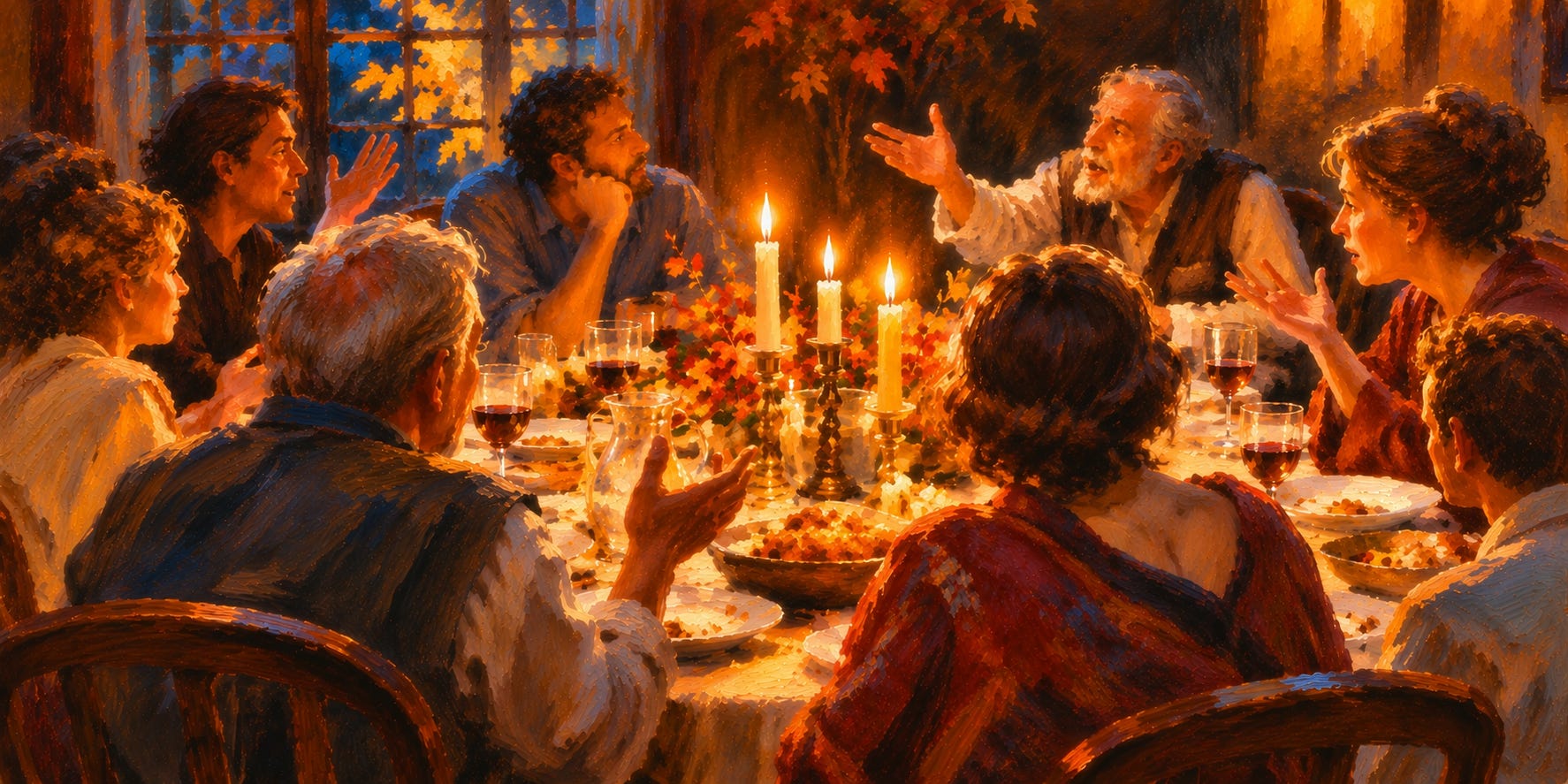
And then there are the unchosen crucibles. You may have an uncle Bill who annually insists on regaling your tryptophan-addled family with the latest crimes and conspiracies of political party X, “the crazy one,” knowing full well you’re a member. You may feel that you know with every fiber of your being that Bill’s the one who’s nuts, and it’s so hard not to push back.
But what if you are “Uncle Bill” to Uncle Bill?
Do we have the courage to reexamine our cherished beliefs from time to time? Maybe he’s right. Either way, he’s your uncle and he’s at the family gathering. What a gift it might be to be able to let him have his say, reject it internally, and then attempt to connect over something else. Better yet, what if we could actually become curious about how he came to see the world the way he does? Not because we expect to agree with him, or even because we think there’s much chance of changing his mind, but because he’s a human being with a history, a set of experiences, fears, and hopes that have shaped his understanding of the world. Perhaps we could leave the table with our political convictions entirely intact, but with a slightly more expansive understanding of another person.
And maybe that’s the point. The people who most challenge our patience, tolerance, and understanding are the very people who give us the opportunity to develop them. It’s not much of an accomplishment to love people who are easy to love. The real work begins with the ones who aren’t.