


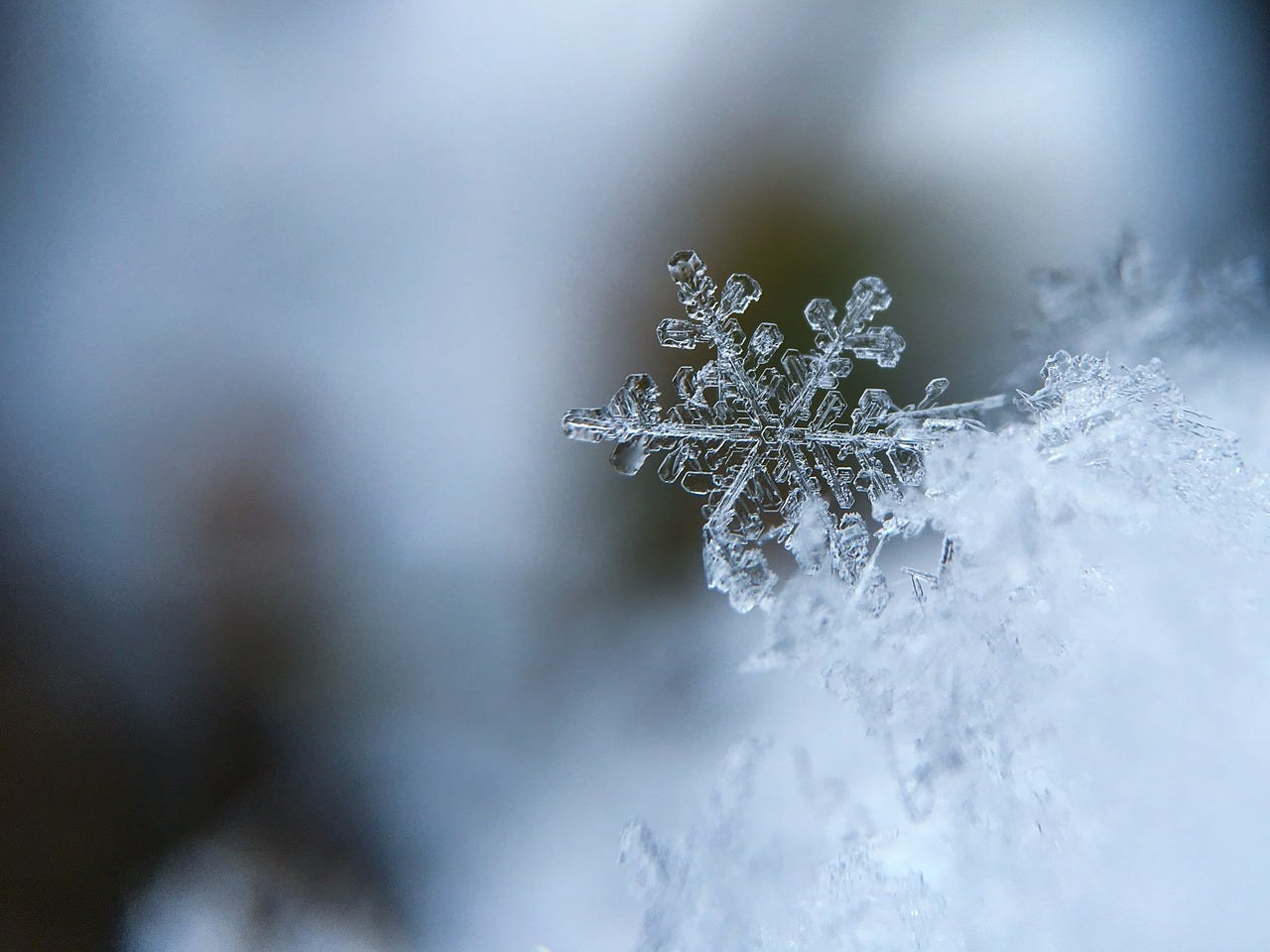
Image: travelingmitch.com
The Hope of Midwinter
This time of year, for most people in my part of the world, it’s simultaneously winter and Christmas.
In much of the northern European imagination, as in much of north America’s, midwinter and Christmas not only coincide but are inextricably linked. Here they have fused into a single holiday season, with the symbolism of the Middle Eastern nativity story – mangers, stars, presents – overlapping with the midwinter imagery of pine trees, snow and mistletoe. The two events have even combined in the mythical personification of Christmas, with the spirit of winter (Father Christmas/Père Noël) also being the gift-giving Saint Nicholas of Myra (Sintaklaas/Santa Claus).
I raise this seasonal intertwining because the similarities and differences between Christmas and midwinter tell us something about life, ethics and indeed, the future of our planet.
This is a bold claim, I’ll admit – but to see what I mean, let’s start with a central difference between the two.
This is the degree to which they embody hope.
For nearly all of human history – and even today, in some parts of the globe – the winter was a force to be respected, perhaps even feared. Cold weather meant less food, less daylight, and harsh conditions. At the mercy of the climate, human beings came to celebrate midwinter since it is, of course, the turning point in that season. As the days begin to lengthen, the hope of easier times grows during the long cold nights.
Then there’s the nativity story, which is a tale of hope and goodness through and through. Of course, it also takes place against a backdrop of challenges: the very reason Joseph and Mary had to return to Bethlehem was to register their place of origin in a Roman census, in order that taxes could be levied. Then, as every schoolchild knows, there was the struggle to find a place in Bethlehem in which to stay.
Beyond that, however, the nativity story is a positive one. For Christians it recounts the birth of the messiah, holiness taking the delicate form of an infant human; for non-believers and adherents of other religions, it remains a beautifully human story of birth and parental devotion in adverse conditions.
Even if we do not share a belief in Jesus’ divinity, therefore, the symbolic intertwining of Christmas and midwinter lends an optimistic hue to an otherwise challenging time of year.
A New Responsibility for Nature

Image: Has Jonas, felsefe.gen.tr
At least, this was how many people traditionally experienced winter in Northern Europe. Now, however, plenty of people are starting to see it in a different light.
The change is that winter itself is changing. Average temperatures are rising, with the UK regularly seeing warmer and wetter winters – indeed, six of the ten warmest UK winters on record have occurred since 2000.
What does this change look like in less abstract terms? More rainfall and fewer frosts, certainly, but also unseasonal behaviour from plants and animals. In southern England this winter I’ve seen bees in the garden, daffodils shooting up, and even apple trees blossoming – the latter usually only starting here in March or April.
As we all know, there is currently no public consensus on the cause of the unseasonal warmth that’s visibly changing local ecology. But that it is happening is clear, and many people believe it to be the result of two centuries of industrial activity.
One of those people was Hans Jonas: one of the first and greatest philosophers of the environment. According to Jonas, the changing relation between human beings and the natural world entails a change in ethics. Indeed, he goes so far as to say that it gives rise to an ethical imperative that never previously applied in human history.
This new ethical imperative is nothing less than responsibility of the future of life on Earth.
The philosophical justification offered by Jonas for this idea is impressively thorough, but the gist is as follows: when (mature) human beings obtain power over a vulnerable good, they become responsible for its welfare.
The archetypical, strongest, and most commonly experienced example of this ethical relation is a parent’s responsibility for their newborn child. The parent is a mature adult, while the infant represents the purest good, and the former’s power over the latter’s welfare is initially total, only receding as the child themselves grows into an adult.
While responsibility for an infant is the perfect instance of this form of ethics, it also applies in any situation where mature humans gain power over a vulnerable good. According to Jonas, now that human beings have acquired the power to shape the natural world (of which we are otherwise a part), we have responsibility for it too. In other words, nature – which is good both because it allows us to live, and because it contains a plenitude of lifeforms and beauty – now appears vulnerable to our activity. Until the last century that statement might have appeared bizarre, even scandalous – but Jonas believes that it now reflects our predicament.
The upshot is that, for many people, the way in which the winter has appeared to us for centuries is changing. We are no longer entirely at the mercy of the seasons, awaiting the arrival of spring and celebrating midwinter for that reason. We are instead shaping the seasons, and accordingly now have a kind of responsibility for them.
For those, like me, who are persuaded of Jonas’ arguments, his line of thinking leads to a strange twist of fate. This is that our relation to the natural world is now ethically closer to the nativity story – in being a form of responsibility – than our previous largely amoral relation to nature. In the present day the natural world in general, and winter in particular, no longer appear as threatening as they once did. Instead they appear newly vulnerable and precious. The world presents itself as a gift comprising of a near-infinite plenitude of living and non-living beings, with winter as its increasingly fragile repose.
Whether or not you find these reflections persuasive, there is still a common ground for hope: that the midwinter is past, and that a traditional spring might come.
All 50 States: A Passport to Your Mind: A new program for paid subscribers.
Each week, you’ll get a guided exploration of a single state of mind — from everyday states like focus, flow, and daydreaming, to deeper emotional, meditative, and contemplative states we all pass through in the course of a human life.
(If you’re already a paid subscriber and would like to receive the All 50 States email, click here).

Winter began on December 21st. True that was the Solstice and the longest time of darkness. But midwinter is more like February 20th. Other than that, yes, we do need to care for our environment.