


Image: rarehistoricalphotos.com
When History Becomes Heaven
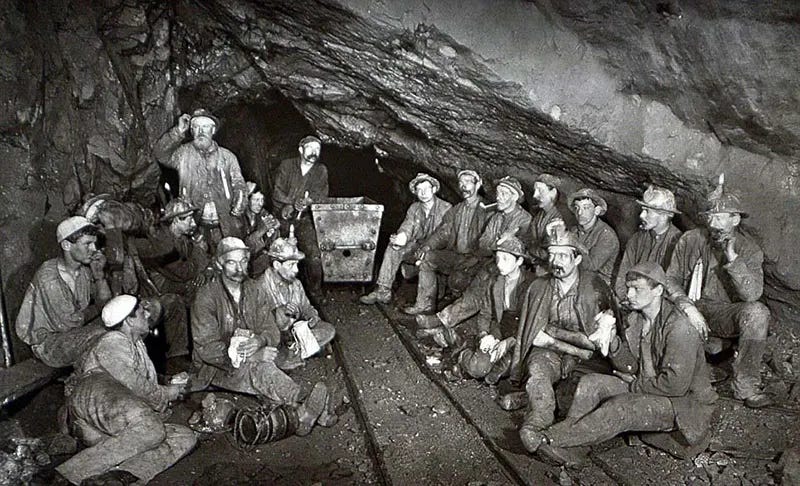
Imagine spending the majority of your waking hours 1,000 feet below ground. Your daily routine involves getting up at 4:00 AM. You wake already tired. Coffee goes down fast. A slab of buttered bread—breakfast and lunch—disappears into your satchel. Then the shaft. The mine in which you, your children, and everyone in your town work alternates from freezing and wet to intolerably sweltering. The timbering that is holding back the mine from collapse is dicey at best. Everyone you know is pale, underfed, and prematurely old.
This is 19th-century France as depicted by Emile Zola in his highly compelling novel Germinal. It tells the story of what happens when deprivation becomes intolerable and resentment begins to organize itself. Zola chose the title Germinal to evoke what grows unseen beneath the surface—the slow work of germination in darkness and pressure. Something is growing. The question is: what? Will it flower into justice—or into fury? The answer may depend on what has first been planted in the human heart—and how it’s cultivated.
When the mining company announces a wage reduction, justified as economic necessity, it pushes an already starving workforce past its breaking point. For people living at subsistence, the cut is the final straw. A general strike forms around Étienne, the novel’s restless protagonist. He speaks not of wages, but of destiny. When the strike brings capital to its knees, a new dawn will break—brotherhood, fairness, and dignity. The old world will crumble and be replaced with a glorious bastion of rights and prosperity. Étienne is no longer merely an organizer. He becomes a redeemer. But after two months without food, with the company unbroken, hope curdles into violence.
The miners are not foolish to hope. Humans are built for hope. We are drawn to figures who promise transcendence—who speak not merely of reform but of redemption. These are potent forces. Zola paints a portrait of what happens when politics becomes end of days hope—when the struggle between labor and capital is invested with the promise of salvation, and the desire for utopia grows so strong that almost any means begins to feel justified.
One of the striking features of the novel is the near absence of traditional spirituality. The characters operate as though governed by immutable laws—of physics and economics. They are trapped within a closed system, sealed off from transcendence. There are no appeals to a Higher Power. The local priesthood is dismissed as an arm of the bourgeoisie—mocked, distrusted, and irrelevant. In Zola’s world, there is no heaven. There is only history.
Social mores fray under pressure. Children are promiscuous. Neighbors slander and backstab. Men brawl in the pubs. Like the coal they depend on, the miners are subjected to relentless compression. It is purgatorial—and yet there is no heaven beyond it. With no transcendent horizon, redemption can only be sought through history. Politics becomes the sole vessel of hope. The deeper question is whether another seed—one capable of absorbing and transforming suffering—might have altered not only their fate, but the novel’s grim conclusion.
When Heaven Returns to Earth
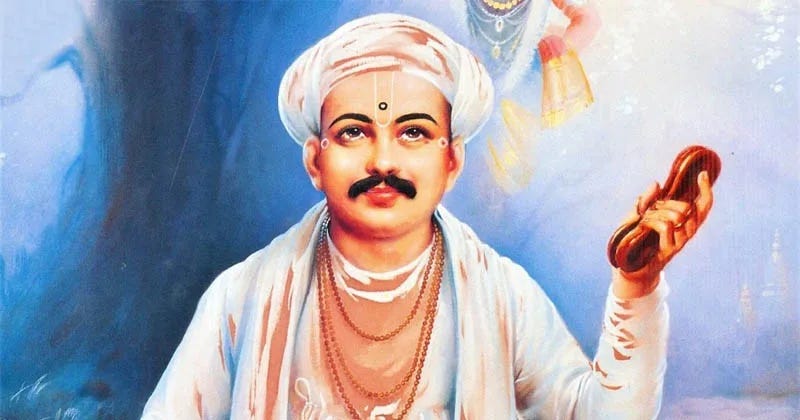
Image: Tukaram, mypunepulse.com
And yet there have been communities just as poor, just as constrained, in which something very different germinated. In 17th-century India, the poet Tukaram lived under crushing debt and public humiliation. “I have no wealth or status,” he wrote. “My only treasure is the Name of God.” Tukaram was a practitioner of Bhakti, a devotional movement that emphasized surrender, direct access to the Divine, and spiritual equality across caste lines. In this system, poverty did not disappear. It was relativized. It ceased to be ultimate.
By redirecting longing upward rather than horizontally, Bhakti transformed deprivation into devotion. Among laborers and lower castes, it inspired ecstatic poetry and a fierce sense of spiritual dignity. Unlike Étienne, whose political salvation collapses into violence, Bhakti figures such as Kabir sought revolution in the inner world. God, Kabir insisted, was accessible to anyone who loved. Their practices required no wealth, no institutional power, and no historical upheaval. They only required devotion.
This pattern is not unique to India. In the impoverished Jewish villages of Eastern Europe, Hasidic teachers often spoke of a seed buried in winter soil. To the eye it appears lifeless, even decayed. In truth, its concealment is gestation. What looks like death is the beginning of growth.
Similar currents surfaced elsewhere—early monastic communities, devotional movements across continents—places where material scarcity pressed hard, but transcendence pressed back. Poverty was the common soil. The seed was different.
What We Are Planting Now
We are not miners in 19th-century France. Most of us are wealthier and more comfortable than any generation before us. And yet our public life often feels as volatile as Zola’s fictional strike. We inhabit an “us versus them” atmosphere in which every election feels apocalyptic and every policy dispute existential. Many live in perpetual outrage. Politics has become all-consuming, even a kind of counterfeit religion—complete with passion, devotion, and absolute tenets, but stripped of transcendence. And like all counterfeit religions, it divides the world into believers and heretics. Disagreement becomes betrayal. Loss becomes apocalypse, and compromise becomes sin.
Zola’s cautionary tale reminds us that underground pressure can, when improperly channeled, explode into blood-letting. That same pressure, filtered through a worldview that affirms life as meaningful and beauty as possible even in inhospitable soil, can germinate into something life-affirming. The pressure beneath the surface is inevitable. The question is what we are planting.
Each week, you’ll get a guided exploration of a single state of mind — from everyday states like focus, flow, and daydreaming, to deeper emotional, meditative, and contemplative states we all pass through in the course of a human life.
Think of it like a map + travel guide:
Clusters / Regions (like US regions):
Everyday States = “The Lowlands” (common terrain of life).
Emotional States = “The Heartlands.”
Meditative States = “The Mountains” (higher elevations of awareness).
Altered / Substance-Induced States = “The Islands.”
Mystical / Transpersonal States = “The Skies.”
Extreme / Edge States = “The Deserts & Depths.”
(If you’re already a paid subscriber and would like to receive the All 50 States email, click here).
That novel you start with made me think of the DORA concentration camp within Nazi Germany. I think it might have been in Penemunde (sp?). Unfortunately, it is politics that influences our lives and the circumstances under which we live.
So good!