


A 90-year-old John Adams is walking in the fields with his son John Quincy. He tells him:
“I have seen a queen in France with 18 million livres of diamond on her person. But I declare, that all the charms of her face and figure, added to all the glitter of her jewels, did not impress me as much as that little shrub — right there.”
He points his walking stick at a sprig of Queen Anne’s Lace.
“Your mother always said that I never delighted enough in the mundane. But now I find that if I look at even the smallest thing, my imagination begins to roam the Milky Way. Rejoice evermore! Rejoice evermore!”
This scene, aired late in the 2008 HBO miniseries John Adams starring Paul Giamatti, embedded itself deep into the “highly moving things” file I have somewhere in my mind. Adams was a revolutionary at heart — a man of passion and principle who had dedicated most of his adult life to midwifing the United States. Yet here he was, nearing the end of his days, having finally arrived at the recognition that he had missed something utterly essential.
We’ve always known this. The wisdom isn’t hidden — it’s been sitting in plain sight for as long as anyone can remember, trying to get our attention through every available channel.
“Take time to smell the roses.” How many times have you heard that? Enough times that it has stopped meaning anything — which is the problem. The song Feelin’ Groovy asks that “the morning-time drop all its petals on me.” Wordsworth built an entire poetic philosophy around the idea that a field of daffodils could fill a man with wealth he’d spend the rest of his life drawing on. The Psalms are saturated with it — the heavens declaring glory, the earth full of goodness, every created thing an occasion for wonder.
The message has arrived from every direction. And we have nodded along, agreed in principle, and gone back to our screens.
The real revolution, it turns out, is the counterintuitive act of stopping. Of actually seeing what’s there. Adams knew this at ninety. The question is whether we have to wait that long.
Victor of Aveyron was a boy discovered in the forests of southern France in 1800, apparently having survived alone in the wild from a very young age. A young physician named Jean Marc Gaspard Itard took him in and spent years trying to educate him. The documented accounts describe Victor as completely indifferent to beauty in any form — flowers, music, sunsets, art meant nothing to him. He responded only to functional things: food, warmth, physical sensation. The capacity for aesthetic appreciation — for seeing something and being moved by it — simply hadn’t developed.
So while it might be tempting to think that the ability to see beauty in the mundane spontaneously generates on its own, it seems rather to be a latent capacity — something that needs to be tended and nurtured to fully emerge. Like most skills worth having, it has to be worked into a habit, a practice, a way of moving through the world. The good news is that it’s entirely available to you. The harder news is that most of us — caught in the Sturm und Drang of daily life, its commitments and strivings and endless problem-solving — never quite take it on.
Which brings us to Alice Walker.
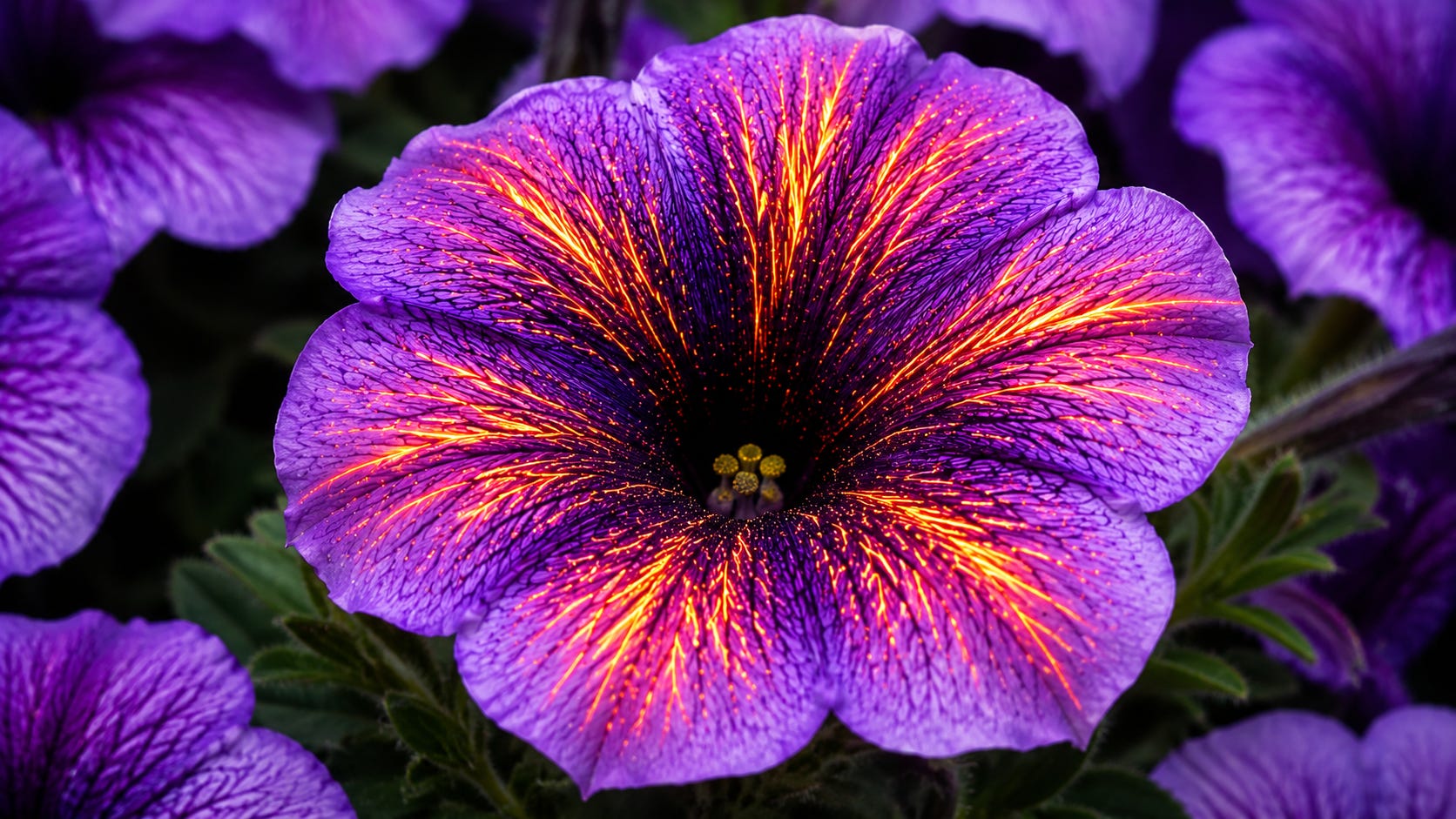
In her poem “The Nature of This Flower Is to Bloom,” Walker describes a flower blooming not for admiration, not for an audience, but, gloriously, for itself. And only for deserving eyes.
That word, deserving, is important. The flower doesn’t withhold itself out of cruelty. It simply blooms at a frequency that only certain eyes are tuned to receive. Walker ends the poem with two words:
Revolutionary Petunia.
The revolution Adams arrived at late. The one that’s available to you right now.
So where do you start?
Try this with a friend: challenge each other to describe an object in every imaginable way for a full sixty seconds. Then switch. You’ll be surprised how much is there when you’re forced to actually look.
Or set a phone alarm for a random time each day. When it goes off, pause, look around, and find one thing in the scene you have never noticed before. It doesn’t have to be remarkable — just previously unseen. That’s the practice. The unremarkable becoming visible is how it begins.
And if you want a guide into what deserving eyes actually see, James Payne’s video series Great Art Explained is a revelation — ordinary people discovering that what they assumed was beyond them was available all along.
Adams had his walking stick, his fields, his Queen Anne’s Lace. Walker had her petunia. You have whatever is in front of you right now.
The world is already in bloom. The only question is whether your eyes are ready to see it.
Q: What is one thing you have walked past a thousand times without truly seeing?
Or,
Q: What is one thing you have walked through a thousand times without truly seeing? (what is that in which we live and move and have our being)
Or
What is it that sees through the eyes, but which the eyes don't see? (Kena Upanishad)
Or
How is it that there is nothing to see but the infinite and Eternal and yet we have eyes but do not see, ears yet do not hear (that which hears through the ears but the ears do not hear)
What is here right now? Is it a particular thing or sight we're looking past, or everything which we're blind to?
People ask mournfully about the mystery of God's alleged hiddenness?
What if the Shekhinah is as revolutionarily (or evolutionarily) present in the screen, in your fingers, in the world around you, in your body, your breathing, your feelings, emotions, thoughts, memories, ideas, in the very spark with Rabbi Nachman exhorts us all to recognize at the center of our being? As much present as the petunia, or Blake's palm of the hand, or the Logic pro audio editing I really should get back to?
Gifted as we are with 5 senses, beyond the self-preservation to see fire, to hear sirens, etc. - in our haste and pursuit of the immediate, we sail above the details, the 'fine print' of Life, ours and there for the taking.
This beautiful invitation, Adam, is received with gratitude: beauty abounds and surrounds.
For openers, Shabbat Shalom.