




For some of us, this is the most hopeful time of year. As pitchers and catchers report to spring training camps in Florida and Arizona, the present is just a gateway to an indeterminate future, a realm of delicious possibility in which our team may have the ingredients for that magical season we will remember for generations. “This could be our year,” the fans of every franchise tell themselves. As we gaze out the window at snow-covered ground, we read about players gathering in the sunshine for meaningless “Grapefruit League” and “Cactus League” matchups featuring players we may never cheer for again. We daydream of a World Series championship run.
But of all the greats who live on in their playoff glory, perhaps the ballplayer who should come to mind is Ernie Banks, a Hall of Famer who never won a championship ring, but whose orientation to the game and life offers a joyful counterpoint to that espoused by the great French existentialists Jean-Paul Sartre and Albert Camus. Banks gives us the secret to a meaningful life: joyful engagement, even in the face of defeat.
Mr. Cub
Ernie Banks’ nickname was “Mr. Sunshine.” He is widely regarded as one of the nicest people to play the game of baseball, someone who was universally beloved for his joyful, caring demeanor. The catchphrase for which he became famous was “Let’s play two!” He loved the sport of baseball so much that one game was never enough.
Despite the drive and talent to win back-to-back Most Valuable Player awards in 1958 and 1959, it was never all about him. He was a part of a team, and being a great teammate was his nature. In an interview, he once said, “My whole life, I’ve just wanted to make people better.”
It is always easy to be kind when things are good. When you have enough, it is straightforward to share your bounty with others. A lack of scarcity breeds generosity. But when times are hard, people turn inward, protecting their own.
Banks’ other nickname was “Mr. Cub,” who played his entire career in Chicago for a team that is legendary for its lack of success. Winning is fun. Losing is both the opposite of winning and the opposite of fun. And the Cubbies were infamous for losing. Their home ballpark is Wrigley Field in Chicago. Early April games in the shadow of Lake Michigan are cold and windy, not the most enjoyable weather to be out in for nine innings.
So, when Banks would say “Let’s play two!”, he was not saying that it is a blast to keep winning or that it is just too gorgeous a day not to be out playing ball. No—his encouragement was to play for another three hours, an additional game his Cubs would likely also lose. For Banks, the reward was not in the outcome, not in the triumph, not in the ability to assert dominance over the opposition. Rather, it was the act of playing itself that was not only valuable but also the source of joy. Yes, it is more fun to win, but the real secret is to enjoy each moment of the playing.
To Be Is To Do
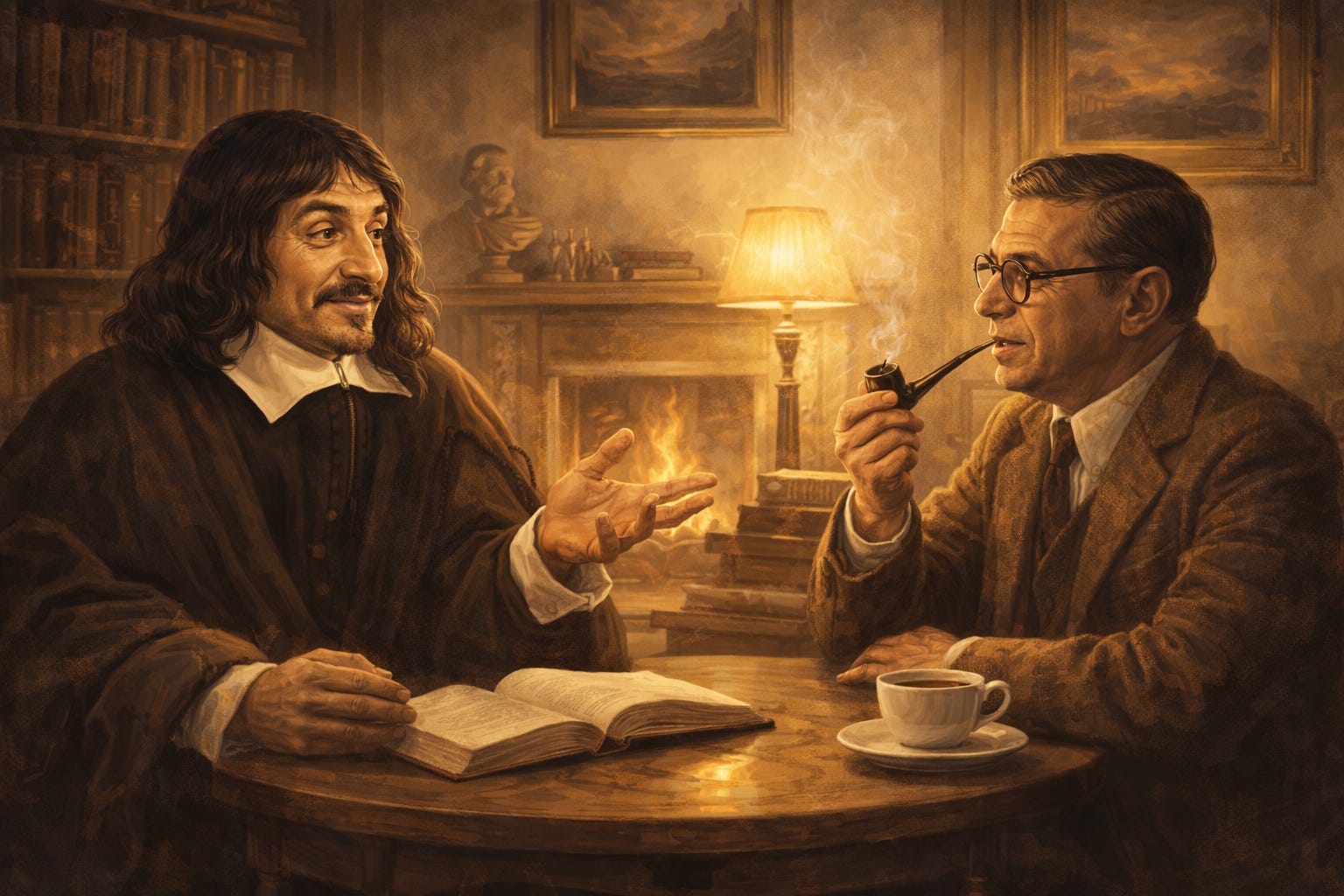
The late 19th and early 20th centuries saw the rise of a philosophical movement called existentialism. For the existentialist, the essence of humanity is freedom. We are by nature radically free. There is no human nature. We are not forced to be anything in particular. We are born the blank slates that John Locke contended a century and a half earlier.
But that freedom comes with a cost. Being free means not being anything. If there was a human nature, then we could blame it for who we are. Without one, we have the responsibility of creating ourselves. You, and you alone, shoulder the entire burden for figuring out who you should be, what it is to live the life you should lead, and then making yourself that way in the world. You have to think about who you are as a human, what makes you the “you” you are.
But that is the easy part. The hard part is that you then have to actually live life in good faith—that is, live according to the way you have figured out you should. You have to make your ought into an is, and you do so by acting. Life is not a thing; it is an activity. Existence is not something you are given; it is something you create, something you construct, something you design and then build.
René Descartes, in the 1640s, worried about the question of existence. How do I know I am real? He concluded with his famous “I think, therefore I am,” contending that because thinking is an action, it requires an actor. To do is to be. In the 1940s, Jean-Paul Sartre inverted this equation. The great existentialist thinker argued that Descartes had it backward: To be is to do. Existence requires asserting oneself in the world, through the world, on the world.
We are who we are because we do what we do. When you act, you create yourself as the person who did what you did. You are only a baseball player if you play baseball. You are only an artist if you make art. You are only a caring person if you care for others. You are who and what you are because you do what you do. Aspirations are meaningless unless they are backed up by action. Someone who doesn’t do anything isn’t anyone. We are what we do.
One Must Imagine Sisyphus Happy
Sartre’s fellow existentialist Albert Camus takes this line and extends it. If we are what we do and we are radically free, then we could be anything. This seems liberating. We all have dreams. Go live your dream.
But, Camus points out, we do not live in a dream world. We live in the real world. And that can be a nasty place. The world puts speed bumps in our path, only to then erect walls. In real life, our fantasies are challenged if not outright quashed. We have the ultimate freedom to create ourselves, but we have to do so in a universe that does not care, and that will often sabotage our good-faith efforts. Life is a contact sport. Being a human often hurts.
Yet, we inherit the ultimate responsibility: to decide who we ought to be and then to become it. We have no choice if we want to live.
And why should we? If we have to decide who we should be in a world that will likely disallow it, why should we exist at all? The only philosophical question, Camus writes, is why we should not commit suicide.
We are like the mythical figure of Sisyphus, who was condemned for his crime of trying to gain the secret of immortality for humanity with an unending torture. He had to roll a heavy boulder to the top of an increasingly steep mountain. He struggled and strained to roll the rock, and inevitably, as he approached the summit, the terrain would turn upward at such an angle that the boulder would roll over him and back down to the bottom, where he would have to start again.
The torture, Camus points out, is not in the physical exertion. Yes, it was hard, painful work. But Camus points to the moment where Sisyphus, just steps away from the apex, must pivot, look at the bottom of the trail, and know in his heart that he can never accomplish the thing he must do. He then must take that first step back down, knowing what awaits him, knowing the pain to come, knowing of the inevitable failure again.
But, Camus argues, there is one way that Sisyphus can escape. He can avoid the punishment—not by running away, but through a change of mind. If he decides that he wants to roll the rock, if he makes it his choice, then he reclaims his autonomy, his humanity. In Camus’ eyes, this is a middle finger to the gods who punish him. It is an act of scorn. “Just try to take my personhood away from me; I will reclaim it,” Sisyphus declares. Scorn, Camus argues, is what we need in a world that conspires against us in order to affirm ourselves.
Eternal Sunshine of the Loving Mind
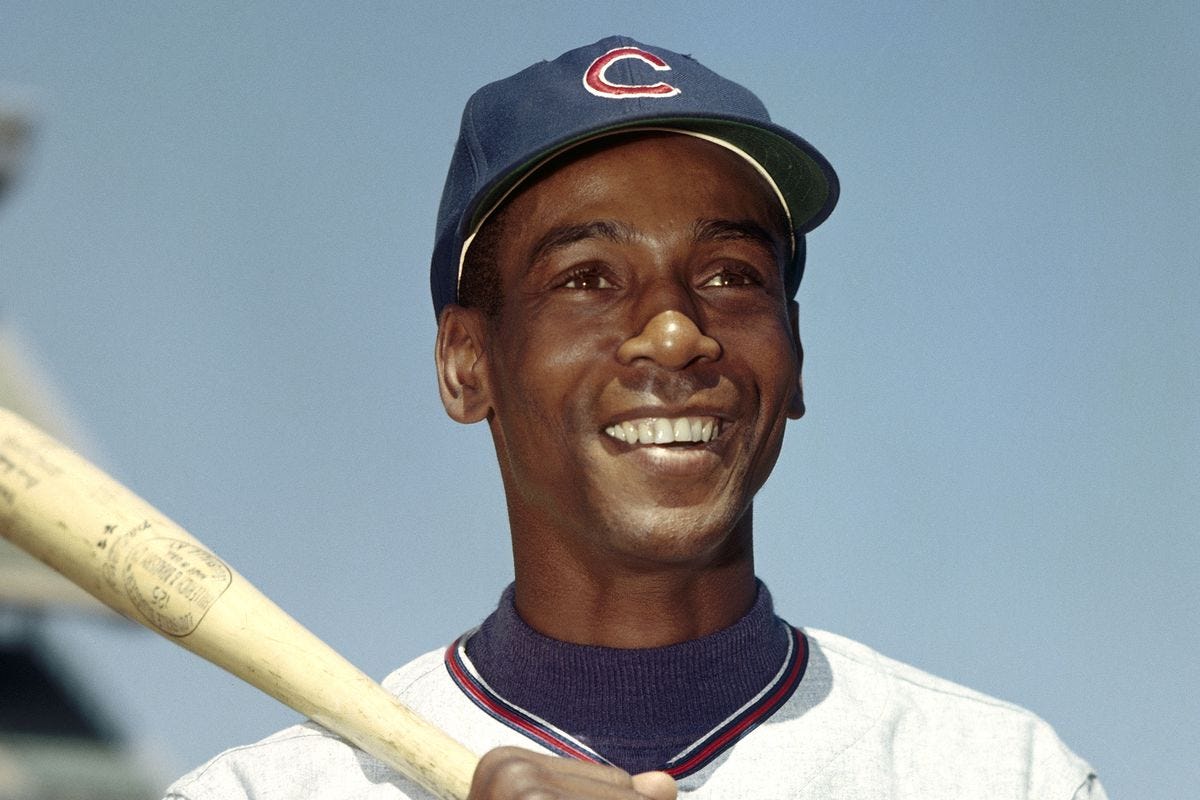
Image: Ernie Banks, bleedcubbieblue.com
If there was ever anyone like Sisyphus, it was Ernie Banks. While every baseball fan in February bathes in the gleam of hope that this will be their year, Banks went to camp knowing that it most likely would not. The point of playing the season was to crown a champ. Banks would play his heart out to win games, to make the post-season, to celebrate in the locker room drenched with champagne. Like Sisyphus standing at the top of the mountain having to take that first step down to his boulder, he knew where the campaign would ultimately lead.
But what made Ernie Banks so extraordinary was that he did not give in to Camus’s scorn. Mr. Sunshine took another direction. He appreciated the progress; he embraced the grind; he stopped thinking about the forest and appreciated each tree. It was the love of the game and the appreciation of those who were there with him that gave it value. It was not the destination, but the glory of being able to take the next step that deserved celebration.
Ernie Banks was a baseball player because he played baseball. The existentialists had that correct. But what drove him to continue his existence as such was not scorn, but love. In reveling in the joy of the playing, the glory of the moment, the exchange on a double-play with his second baseman, Ernie Banks gives us a model for a well-lived life. There will always be sorrows and challenges, but we have to embrace those with us and the fact that we get to play—even if we lose, even if it is a blustery cold Chicago day. We have to look at the world as it is and say with authentic joy, “Let’s play two.”

Each week, you’ll get a guided exploration of a single state of mind — from everyday states like focus, flow, and daydreaming, to deeper emotional, meditative, and contemplative states we all pass through in the course of a human life.
Think of it like a map + travel guide:
Clusters / Regions (like US regions):
Everyday States = “The Lowlands” (common terrain of life).
Emotional States = “The Heartlands.”
Meditative States = “The Mountains” (higher elevations of awareness).
Altered / Substance-Induced States = “The Islands.”
Mystical / Transpersonal States = “The Skies.”
Extreme / Edge States = “The Deserts & Depths.”
(If you’re already a paid subscriber and would like to receive the All 50 States email, click here).


I needed this today. Let's play two!