


I’m a fan of Sabine Hossenfelder. She’s a German theoretical physicist with a gift for making extremely abstract concepts digestible — and a knack for tossing little thought grenades into the halls of the scientific establishment. Something she posted recently stopped me:
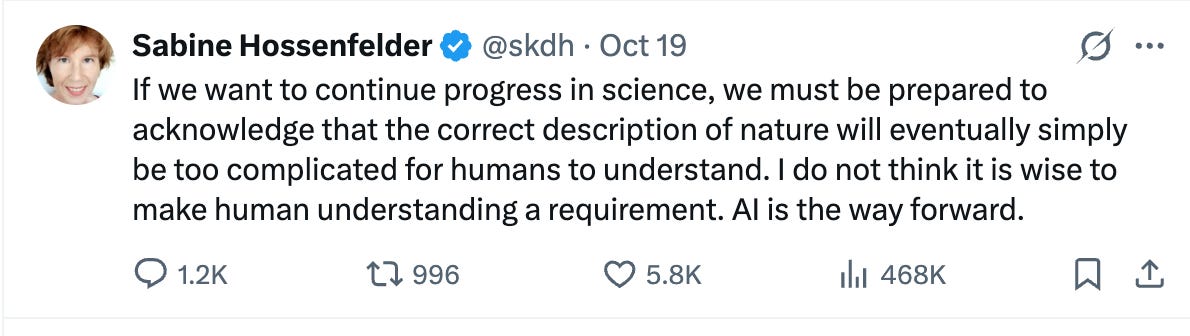
Her claim, in brief: reality is becoming too complex for human minds to grasp, and rather than treat that as a limit on science, we should hand the work of understanding to an artificial intelligence that may one day be equal to it.
At the turn of the twentieth century, much of the scientific community had quietly concluded that physics was essentially a finished project. At the dedication of a new laboratory in 1894, the future Nobel laureate Albert Michelson announced that the fundamental laws of physics “have all been discovered,” and that all that remained was to measure the known quantities “to the sixth place of decimals.”
Within a decade, relativity and quantum mechanics would turn that confidence to rubble. It’s a humbling reminder — not that human understanding is limitless, but that we are remarkably bad at knowing in advance where its limits lie. Which is worth keeping in mind as we weigh Dr. Hossenfelder’s own sweeping claim — and, for that matter, any confident forecast of what machines will one day comprehend.
Though they arrive at it from radically different directions, Dr. Hossenfelder shares one conviction with the mystic: that the mystery of reality may be an unplumbable well. For her, this is a problem to be managed. If human capacity can’t reach the bottom, we outsource our comprehension to an intelligence that may, in time, come to grasp it. Even if that intelligence could never convey the essence of it to our limited minds, it could at least hand us the gist — and for our purposes, that might be enough.
The mystic’s interest lies elsewhere. Our fundamental lack of comprehension is not merely a wall to be scaled. It is a truth to be lived inside — even a doorway to the sacred. The unfathomability is itself a wonder, a delight. It reflects the character the mystic sees in reality itself: infinite. Of course you cannot understand it in full — to do so would be to reduce the irreducible, to corporealize the incorporeal. This is not a reality made to be grasped in toto. It is an unending series of realizations, insights, growth, and relationship. To describe it accurately, completely, would be to sacrifice all of that bounty.
I confess I’m partial to Einstein’s approach. As he put it: “The eternal mystery of the world is its comprehensibility… the fact that it is comprehensible is a miracle.” What moves me is his reach for a non-scientific word — miracle — to name his wonder. I don’t think he meant the universe is, or ever could be, fully comprehensible; only that it is remarkable it should be decipherable on any level at all. He is, to me, the model of the scientist who never let the data crowd out the awe — the opposite of “just hand it to the machine,” which quietly treats the mystery as a means to an end.
And this is where the question underneath the question surfaces. Why is it so important to understand reality? To make use of it? To invent things? Fine — those are real goods, and I’m glad for them. But spiritually speaking, comprehension was never the foundational goal. Our participation — our delving headlong into the miraculousness and seeing what’s there — is. And that is precisely the thing no intelligence can do on our behalf. You can outsource the calculation. You cannot outsource the standing-inside-the-wonder.
One might object that this sets up a false opposition. Dr. Hossenfelder isn’t against wonder; a machine that uncovered something strange and beautiful about the universe might stir more awe in us, not less. True — and worth granting. But notice that the awe would still be ours. The machine could hand us the discovery; it could not do the marveling for us. The finding feeds the encounter. It doesn’t perform it.
These mystics, in any case, lived contentedly with Dr. Hossenfelder’s conclusion for many centuries before she reached it. In different language, under different assumptions, they worked out entire ways of speaking about the ineffable. The opening line of the Tao Te Ching announces it outright: “The Tao that can be named is not the eternal Tao.”
The method is what theologians call apophatic — you approach the thing by saying what it is not. Naming doesn’t capture it; naming shrinks it. The point of the negation isn’t to assemble, piece by piece, a complete picture of what the ineffable is. It’s to loosen our grip on the assumption that our concepts could ever exhaust it. The Kabbalistic Ein Sof — the “Without End,” the Infinite — is approached the same way. And here the limit is not a matter of size.
Ein Sof is not an especially enormous object that no mind is big enough to hold; it is prior to the very distinctions through which we measure and divide anything at all. No amount of added capacity reaches it, because the problem was never capacity. The Tikunei Zohar, in words still recited as part of the liturgy, says of it simply that no thought can grasp it at all.
None of them were wrestling with a problem. They were standing at a doorway. The end of one mode of thinking didn’t close the inquiry — it opened a deeper one.
All of this said, it should be obvious that understanding is a good thing. It gave us antibiotics, commercial air travel, hip replacements, quantum computing. To wave those away — those largely secular gains — would be spiritually arrogant, and a little willfully blind. If anything, we should deepen our material knowledge as far as it will go.
But let’s also notice what kind of road we’re on. Calculation and measurement are one modality — one genuine path toward understanding. And it is a path that stretches on, by its very nature, with no final destination; there is always one more decimal place. A person can walk that road for a lifetime and never once arrive. That’s no reason to abandon it. But it might be reason to ask, when we feel how endless it is, whether there isn’t a second path — one that lets us rest our sore feet and set out on an inward kind of travel instead. A stillness that is also a kind of motion. Why shouldn’t both be open to us?
As someone who loves music, I meet this daily. Sound is about as calculable a thing as exists — a wave of vibrating air, 440 cycles per second for the A an orchestra tunes to, every property of it measurable to as many decimal places as you like. Science can tell us extraordinary things about how sound becomes music: how the ear transmits it, how the brain anticipates a resolving chord, why certain patterns move us.
And yet I do not for a moment believe that a pressure wave in air can, on its own, stir grief or joy or longing in a person. I can’t explain how it works. But I know past all doubt that it does — that something profound happens when I meet it. Perhaps one day a machine will model every mechanism involved, down to the last firing neuron. That would be a genuine achievement. But the model would not be the music. Knowing everything that can be said about an experience is not the same as standing inside it. There was never a gist that would do. There is only something to be present to.
If the correct description of nature eventually outstrips us, let the machines understand it. We still get to stand inside the wonder. That part was never theirs to take.