


theweather.com
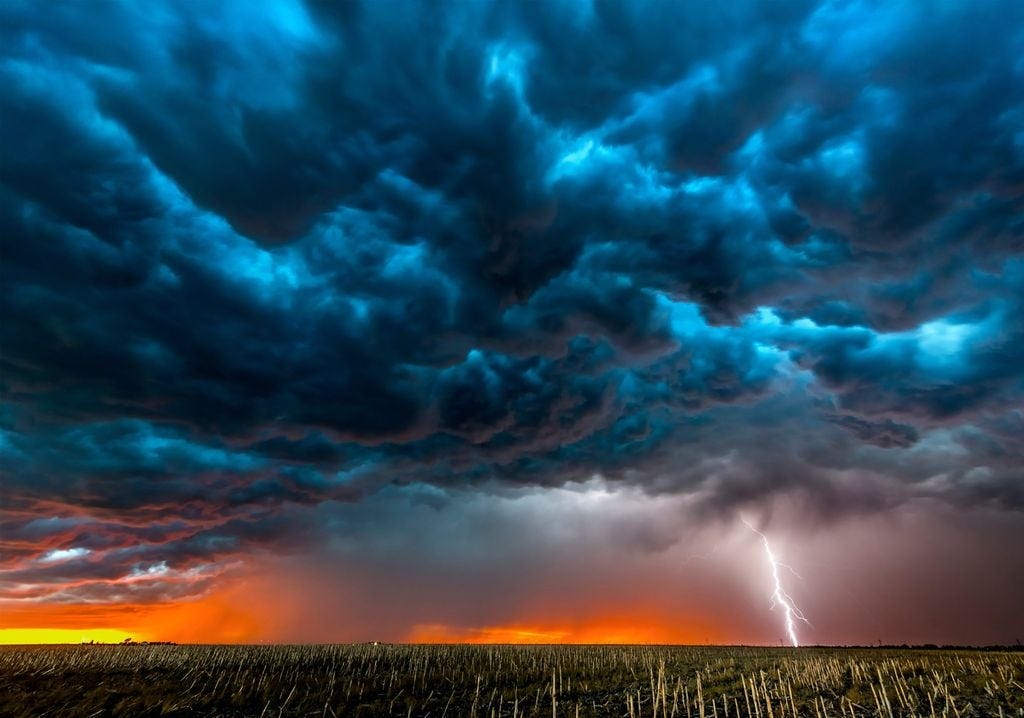
Sometimes fate is like a small sandstorm that keeps changing directions. You change direction but the sandstorm chases you. You turn again, but the storm adjusts. Over and over you play this out, like some ominous dance with death just before dawn. Why? Because this storm isn’t something that blew in from far away, something that has nothing to do with you. This storm is you. Something inside of you. So all you can do is give in to it.
—Haruki Murakami
I once struck up a conversation with an affable young man on a return flight from a very frigid Warsaw. We spoke about the weather there. In the course of the conversation he explained to me that the climate in Poland was a joke compared to his last trip dog-sledding in Northern Norway.
He detailed the days of near white out conditions for days on end with the wind chill making it close to 40 below. I myself thought this sounded like a miserable way to use up all of your vacation days and I asked him if it was worth it voluntarily putting yourself into such extreme weather. I loved his response: “Oh, there’s no bad weather. Just bad clothing.”
Interpretation is one of the most powerful human capacities — and the most underused. Our experience of reality is always filtered through memory, mood, expectation, the story we’re already telling ourselves. There may be facts “out there,” but what we live is always interpretation. Even science, for all its brilliance, only produces data. The moment you ask what it means, you’ve left the lab and entered philosophy.
This fact creates a golden opportunity. Namely, no matter what is happening, we, in theory, get to decide how to feel about it. We can dress for the weather. Let’s think about this.
There are people and situations that trigger you: the rude and inaudible customer sales rep, your vociferous but ignorant political activist niece, the person who embarrasses you in public for something you didn’t even do. It’s virtually automatic — you can’t imagine what it would look like to not “go there.” You may try to resist; to be “bigger” than this encounter, but given enough stimulus you very well may “lose your mind.” This is the storm; the one you made.
The term neuroscientists actually use is “electrical storm” — it’s not just metaphor. During intense emotional states, particularly fear, grief, rage, or panic, there’s a dramatic surge of synchronized electrical activity, especially in the amygdala. In cases like epileptic seizures or severe PTSD episodes, the pattern is close enough to an actual electrical storm that the language is clinical, not poetic.
So what should you do?
There are two ways of dealing with what’s coming. The first is to run. Knowing, as you often do, that the storm is likely to hit in scenarios that are very familiar to you, it makes sense to avoid them to the best of your ability. Unless you’re one of those storm chasers who relish careening their trucks directly at the tornado currently demolishing an Oklahoma hamlet, why put yourself in a position to induce it. Learn to make fences. Stay far away from emotional turmoil and all the damage that comes along with it.
The second option is to shelter in place. This means there’s no escape and it’s going to pound you. There is a spiritual teaching I find compelling for exactly this moment. It posits that inasmuch as we are each created alone — arriving here without consent, inhabiting a consciousness no one else can fully enter — we are all fundamentally enough, all by ourselves. We came in whole. Despite the natural desire for deep and significant connection with those around us, in moments when that connection is not tenable; when the storm of the “other” is raging against us, we can retreat to something that was always already there.
There is a part of you the storm cannot reach.
That state of awareness is real. It doesn’t need approval, agreement, or even respect. It’s in there if you look.
Like an emergency contingency protocol that can be programmed to go into effect under certain circumstances, the human soul has a built-in emotional immunity program. Since many of us don’t know it’s there we have never bothered to turn it on and try it out.
In the meantime, the storms remain teachers. Each is an opportunity to get sick of the game and to look for something different; a way out. To the degree that they goad us into discovering a whole new way of being they are our friends, and it’s possible to welcome them even as we despise them. In the end, the emotional storm is showing us both who we are and what we could become.
This storm is not something that blew in from far away, something that has nothing to do with you. This storm is you.
Q: What would change if you stopped fighting the storm and started asking what it wants?
Thank you for post. It was a nice read this morning. It does seem we come in alone but I don't believe that's true. We come in with a headset that blocks out our real togetherness. We are not separate consciousness, we are one Consciousness expressing in infinite variety. That said, sitting and staying with what arises as this infinite awareness is, as you said, often the wisest choice.
I think the problem is that when we have these storms, they affect the people around us. Our rage can frighten them. It creates a trauma for them. This is why we are told so very often to repress our rage, why we get rage thrown right back at us. Facing one's feelings ALONE is one thing, but doing that when other people are around is still a no-go. We need outlets to express ourselves but controls that make what we say and do less damaging for others.