



Image: neurosciencenews.com
It’s so lonely when you don’t even know yourself…
—The Red Hot Chili Peppers
Dreaming and Waking Sleep
By and large, dreams are nonsensical. For instance, you find yourself in a barn speaking with a cat. Somehow, you know this cat is also your grandmother. You passively listen for a while only to realize that it’s not a cat at all, it’s your college roommate (who is also a superhero) who you are now high-fiving on the triumphant completion of his mission to bring evil-doers to justice. None of this strikes you as odd.
Did the content of your dream enlighten you? Is there, as many have suggested, an interpretation to be found; one that tells you something deep about yourself, or was it just so much cranial blather? It’s hard to say.
What about normative waking life? In some ways a similar phenomenon is at play; your mind flits from one topic to another, easily derailed, generally unfocused, and, were you to speak out loud the contents of your thoughts, often bizarre. Maybe you are asleep all the time.
This is specifically what Armenian mystic G.I. Gurdjieff thought. In his classic work, The Fourth Way, he described different modes of human functioning—each with a particular level of consciousness. In his system, one is asleep up until reaching the fourth level (thereby relegating the vast majority of humanity to a nearly unwakeable slumber). Nonetheless, an opportunity remains; it is theoretically possible to grope your way towards wakefulness. His method? Learn to stop lying.
The Stories We Tell Ourselves
We humans are remarkably good at avoiding truth. We are confident that our views are correct in the extreme and that “the other guy” is a complete neanderthal. We often continue to think this despite ample evidence to the contrary. We buy into adages like “you can’t teach an old dog new tricks,” and “early to bed and early to rise, makes a man, healthy, wealthy and wise” when just a moment’s reflection shows that these are just generalities at best. They tend to masquerade as wisdom, excuse inertia and relieve us of responsibility.
We create personal stories about ourselves that we express to others like “if you had been through what I have, you’d be angry all the time too.” These stories serve to exempt us from the difficult work of taking a cold, hard look inside and undertaking the painful climb to liberate ourselves from this pit of falsehood. None of it is true, and what’s worse, our belief in it is preventing us from seeing the significantly more profound and powerful beings that we actually are.
For instance, I’m one of those people who does not like to say no to others. On occasion, I’ve been told that I need to “set boundaries” or practice more self-care. It’s easy for me to frame this tendency as a positive, “I am going the extra mile to do good things for people,” and that’s true in part. Nonetheless, when I peel back the layers I discover that “part of me” (whatever that means) does not like to be disliked and, deep-down, I fear that disapproval awaits at the end of each “no.” It’s nonsense. It’s just a story. But it has its effect on me.
I notice how quickly a feeling turns into a justification. A flash of irritation becomes a story about someone else’s incompetence, or about how I’m under unusual pressure today. The story arrives fully formed and feels true, but its real function is simpler: it keeps me from asking what I’m actually reacting to.
Learning to Wake Up

Image: talktherapybiz.com
There is a technique that is used to induce “lucid dreaming;” the ability to “wake up” in your dream. Multiple times a day, have a look at a clock or your watch. Take note of the time, look a way for a few seconds and then look back. Has a reasonable amount of time passed? Do the numerals look logical? If so, it’s likely that you are awake. One of the odd features of the dreamscape is that clocks don’t work. If you look at them in a dream, time will not pass at a reasonable rate or the numbers will look like gibberish. The trick is to look, recognize the falsehood, and then awaken within the dream.
Maybe this can be done on waking life as well. If Gurdjieff is correct that our catalogue of falsehoods is what’s keeping us locked in a pavlovian narrative of stimulus and response, perhaps we can begin to bestir ourselves by developing our truth muscles. You might start by noticing how you are feeling—anxious, frustrated, confused? Try to dig down to the root of the feeling and have the courage to ask yourself, “What is the true cause of this?”
The real answer may be frightening or embarrassing. It may challenge long held assumptions about what we’re really like. It could cause disorientation or an unpleasant feeling of groundlessness. If physical waking up is tough, doing it on an emotional and spiritual level is a whole other animal, but it’s also the birth-pangs of a new state of reality; one that is moving you closer to truth, integration, and a deeper awareness of reality and your place within it.
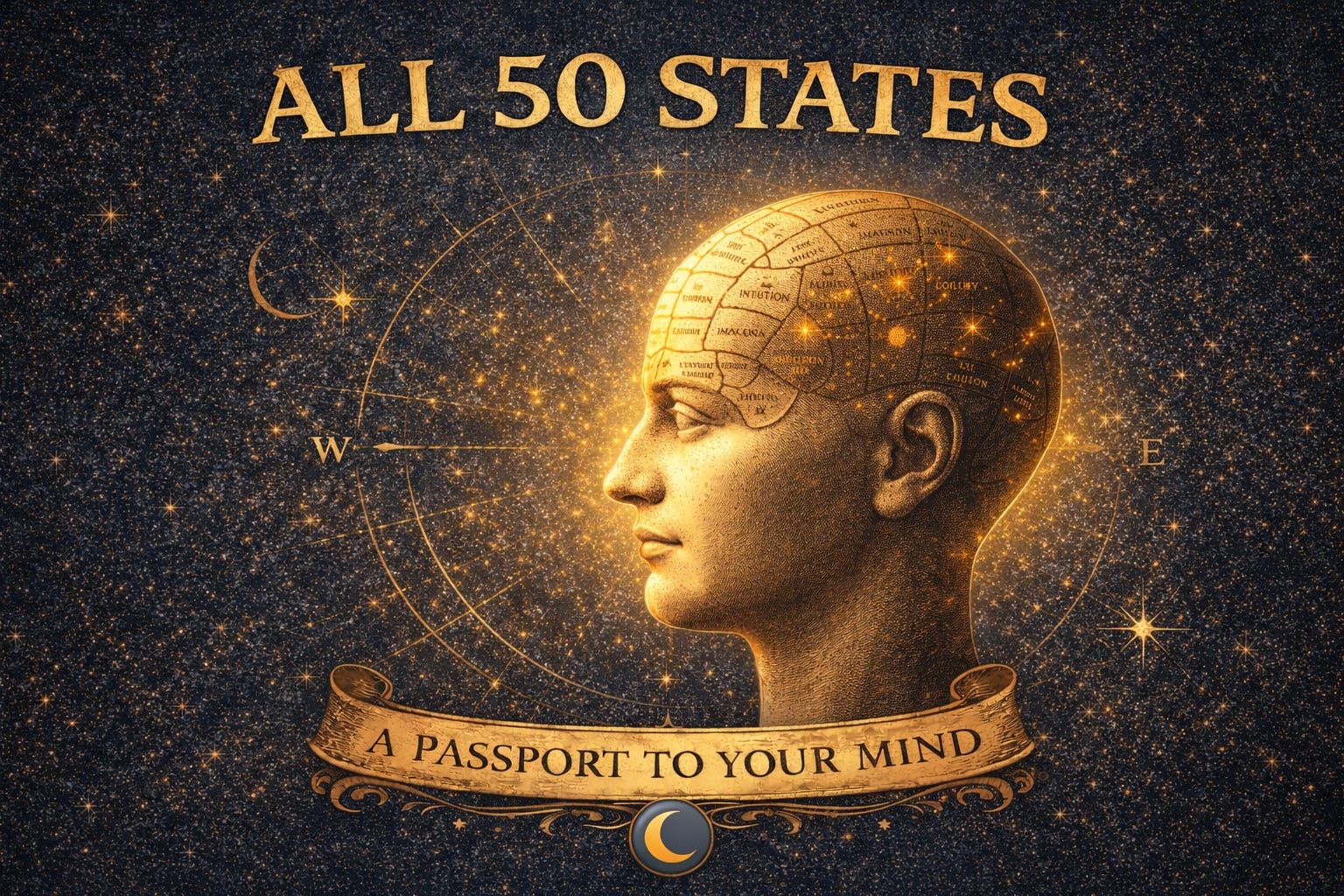
All 50 States: A Passport to Your Mind: A new program for paid subscribers.
Each week, you’ll get a guided exploration of a single state of mind — from everyday states like focus, flow, and daydreaming, to deeper emotional, meditative, and contemplative states we all pass through in the course of a human life.
Think of it like a map + travel guide:
1. Clusters / Regions (like US regions):
Everyday States = “The Lowlands” (common terrain of life).
Emotional States = “The Heartlands.”
Meditative States = “The Mountains” (higher elevations of awareness).
Altered / Substance-Induced States = “The Islands.”
Mystical / Transpersonal States = “The Skies.”
Extreme / Edge States = “The Deserts & Depths.”
(If you’re already a paid subscriber and would like to receive the All 50 States email, click here).