



Image: pxhere.com
One of the most popular philosophical-spiritual ideas is that we should try—at least occasionally—to be at one with nature.
Everything from garden furniture to ayahuasca retreats is marketed according to the idea that the product in question will help us be at one with the natural world.
The sloganised version of this idea, especially when used in a marketing context, might lead us to think that there’s nothing meaningful to it—that it’s just an empty platitude.
I think this would be a mistake. A quick survey of the idea’s philosophical heritage—ranging from Buddhism to Spinoza, and on to the Romantics—suggests that it has serious intellectual backing.
All this invites the questions of what it means to be at one with nature, and whether it’s merely a feeling or instead a genuine insight. At the risk of showing my hand too early, I actually think the answer to the latter question is “both.” Although it’s often a fleeting and perhaps even superficial feeling, it doesn’t have to be—on the contrary, it can be a transformative insight.
First of all, though, let’s look at what we usually mean by being at one with nature.
Being “at one”
If we break the sentence down into its parts, it becomes easier to see where the philosophically tricky bits are.
“Nature” has multiple meanings, but in this context it generally refers to the non-human world. So far, so good.
Things get trickier when we examine what “being at one” with it means. Nevertheless, a clue lies in the contexts in which people typically say they are at one with nature. When we think about this, we notice that most of the time people say they are at one with nature when in a state of repose: sitting on a beach, for example, watching birds fly across the ocean, or lazing in a meadow and feeling the warmth of the sun on one’s face. Rarely will anyone say that they were at one with nature when being aggressively pursued by wasps or fighting off a bout of Salmonella, even though these are arguably more intimate encounters with nature.
In short, people generally say they are at one with nature when the latter makes no demands on them, but rather invites them to calmly lose themselves in its works and beauty. As part of this, our day-to-day concerns—which are so intimately connected to modern urban life—are momentarily suspended. We feel a release as we fold into something bigger, namely the workings of the natural world.
The part and the whole
The above is a beautiful feeling, and one I absolutely wish I experienced more often. The only problem with it, as indicated, is that it tells just half of the story.
If I am at one with nature only when it is at its most beautiful or tranquil, then I overlook the fact that much of nature is neither beautiful nor tranquil, but harsh and violent. We certainly don’t have to celebrate nature red in tooth and claw, but if we ignore it entirely and focus only on nature’s more charming aspects, then we are in fact only at one with part of nature.
On this basis, someone could reply: “OK, in that case, when I say that I am at one with nature, what I really mean is that I feel at one with nature’s beauty.”
This would be a perfectly understandable response—but can we go deeper, and be at one with the whole of nature? I think so, and a deeper approach can be found in the Buddhist tradition.
Inter-being
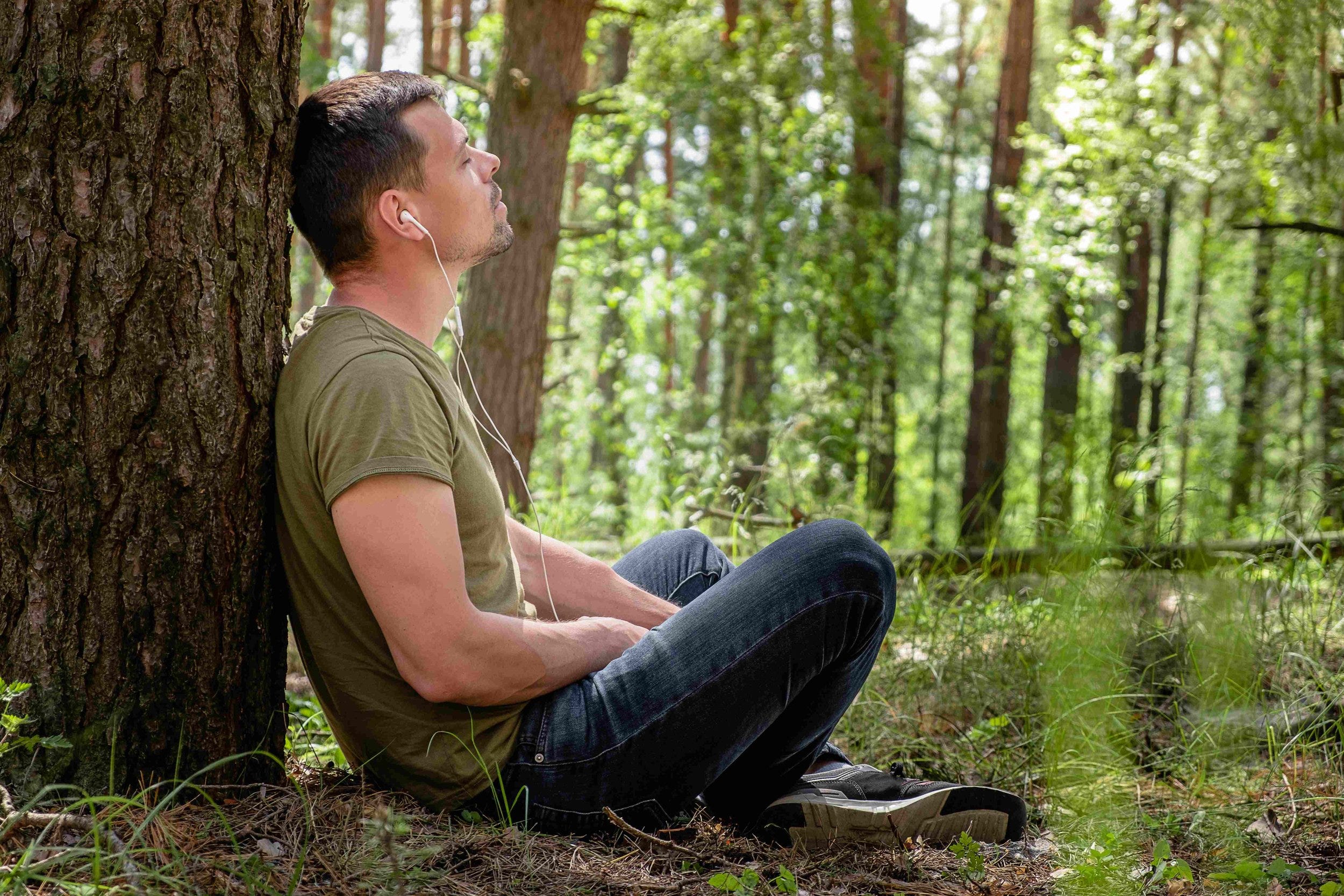
Image: naturefix.life
According to the Buddhist doctrine of dependent co-arising (or inter-being), nothing exists by itself: everything is causally reliant on other beings and is conditioned by them once in existence. This holds not only for things that we human beings create, but also for the products of nature.
What, then, fundamentally informs both our mere existence and our lives once we are in existence? Other human beings, certainly—our biological parents above all. But also—though those of us living in towns and cities are prone to forgetting this—nature.
Consider the following passage from Thich Nhat Hanh, the late Vietnamese Zen Buddhist monk:
At this moment the Earth is above you, below you, all around you, and even inside you. [...] We often forget that the planet we are living on has given us all the elements that make up our bodies. The water in our flesh, our bones, and all the microscopic cells inside our bodies all come from the Earth and are part of the Earth. The Earth is not just the environment we live in. We are the Earth and we are always carrying her within us. (Love Letter to the Earth, p. 8)
The consequence of this observation—which is surely correct—is that the feeling of oneness with nature is generally misunderstood. When we experience it, it is not the case that we momentarily attain oneness with nature, but rather that we see what is always already the case. It is simply a psychological revelation of the underlying reality that we are, through and through, one with nature.
Minding the Earth
If the Buddhist perspective is correct—that we are one with nature, yet only infrequently experience this—how can we more often see what is truly the case? Put more abstractly: how can our psychology (what we think and feel) better align with our ontology (what we are)?
Thich Nhat Hanh’s answer would be to practice mindfulness—and in particular, to practice mindfulness of our fundamental intertwining with nature.
Mindfulness can be described in a number of ways, but one is that it is the application of meditative practice to a given activity. This could be “mere” sitting, or it could be eating, walking, even lovemaking. For example, when I ordinarily eat and drink, I might enjoy the food’s flavours when I first taste them, but before long my focus is elsewhere: on a conversation, a memory, a daydream, or the media. When this happens, the food is no longer really “there” for me at all—let alone the Earth it was drawn from.
When I eat mindfully, however, I try to maintain my focus on what I am eating—which means not only attending to its taste, texture, and aroma, but also bearing in mind whatever else makes it what it is. The carrot is not only sweet, crunchy, and orange (or purple!), but it also “is” the soil, the sun, and the labour that went into harvesting it.
In this way, the apparently simple and individual act of eating—which is all too easily lost to our attention—becomes what it in truth always is: a rich and embodied practice, intimately connected to nature.
Mindful walking, breathing, or sitting can all have the effect of bringing us back to our dependent co-arising with nature—and in this way reveal how we always already are at one with nature.
