


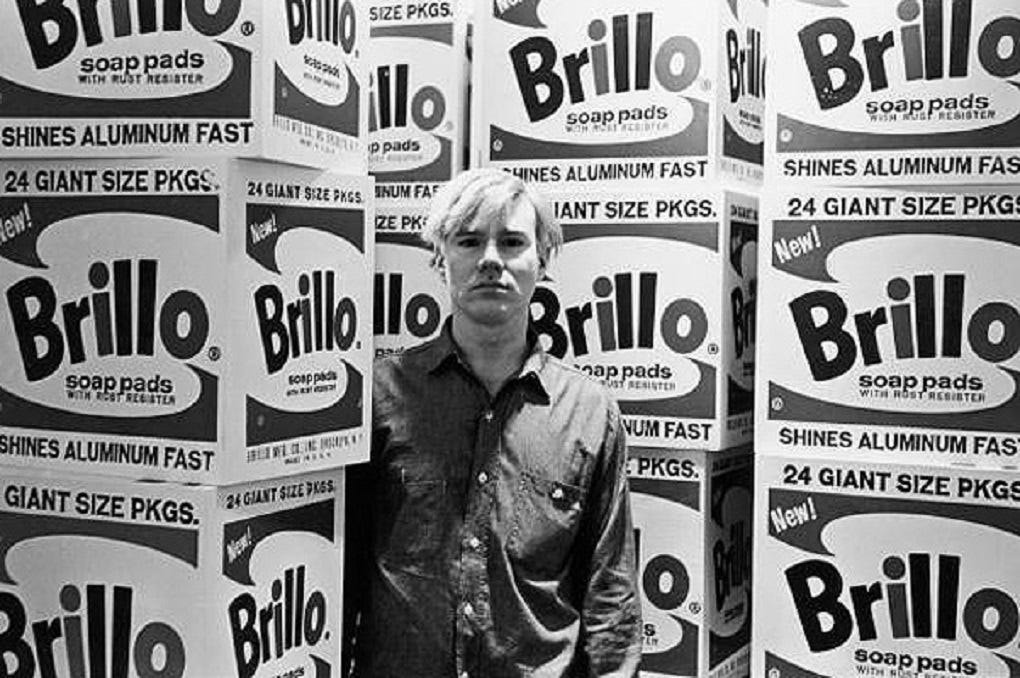
Image: scoutmag.ph
Imagine you work in an art gallery café and are new to the job. One morning, your line manager tells you to head to the gallery’s storeroom and grab a box of Brillo pads to do the washing up with.
You duly head into the backrooms of the gallery and see a large box of Brillo pads. That’s odd, you think: why is the box on a special plinth? Shrugging your shoulders, you grab the box (which is surprisingly heavy), take it back to the café kitchen, dump it on the counter, and open it up with a chopping knife – only to realise you’re not handling a box of Brillo pads at all. In fact, you’ve just used a knife to deface a priceless modern artwork: none other than Andy Warhol’s Brillo Boxes.
Needless to say, if this actually happened, you probably wouldn’t pass your probationary period. But on one level, it would be excusable, since – for those unfamiliar with the artwork – Warhol’s Brillo Boxes are meant to appear indistinguishable from actual boxes of Brillo pads.
For this very reason, the work caused something of a stir when it was first unveiled at the Stable gallery in New York in 1964. Like Marcel Duchamp’s 1917 artwork, Fountain (a signed urinal), Warhol’s Brillo Boxes raised a set of artistic and philosophical problems.
Are the Brillo Boxes beautiful? Are they even trying to be beautiful? If not, do they still count as art? And most fundamentally of all: what is art, anyway?
The sacred and the mundane
For the philosopher and art critic Arthur C. Danto, Warhol’s boxes posed these questions in a uniquely fascinating way.
Danto was educated as a fine artist before switching to philosophy, and unsurprisingly, his area of philosophical expertise turned out to be aesthetics. Aesthetics is the branch of philosophy concerned with beauty, ugliness, the sublime, and the question of what art is.
It is arguably the last of these questions that Brillo Boxes raises best. For millennia prior, great artworks had been seen as sacred: either literally sacred, in the case of works bearing a connection to the divine, or else metaphorically sacred, in the case of works that are of immense beauty and cultural significance.
Of course, an artwork can be all of these things at once, and perhaps the very greatest works are exactly that. Think of Michelangelo’s Pietà, for instance, or the sculptures adorning the temple of Angkor Wat. Both are simultaneously beautiful, culturally significant, and enjoy a connection to the divine.
Interestingly, however, Brillo Boxes has few of these properties. It’s not really beautiful, and far from having a connection to the divine, it very deliberately references the mundane and disposable. For exactly this reason, though, Brillo Boxes is of genuine cultural significance.
How come? Even more than Duchamp’s Fountain – which at least included an artist’s signature – Brillo Boxes performatively elevates the disposable to the level of artwork, a box sitting alongside Renaissance and modern masterpieces. In doing so, it almost dares its audience to deny that it’s art.
But is it, in fact, an artwork?
Transfiguration of the commonplace
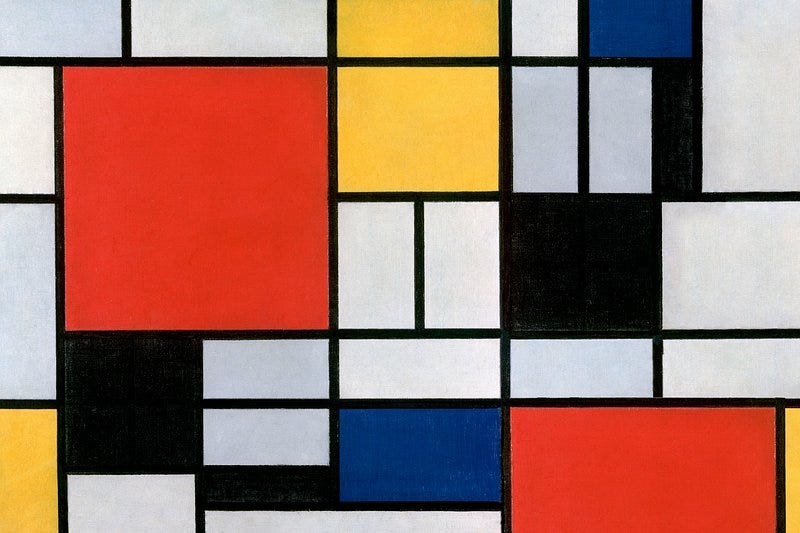
Image: rawpixel.com
Funnily enough, for Danto, the fact that Brillo Boxes poses the question of its own status – asking us, is this not also art? – is part of the reason that it is art.
This sounds quite paradoxical, so let’s break it down. In trying to define what an artwork is, Danto arrives at four criteria. The first is that an artwork has to have a subject. In the case of Michelangelo’s Pietà, for example, the subject is Jesus and Mary at Mount Golgotha. In the case of a very abstract painting, like Mondrian’s Composition with Red, Blue and Yellow, the subject is merely the various colours of the painting.
Danto’s second criterion is that an artwork has to have some sort of attitude or point of view on its subject. Again, taking Pietà as an example, we could say that Michelangelo reverentially depicts Jesus and Mary, whereas Mondrian’s Composition seeks to harmoniously arrange colours.
The third criterion is that an artwork must leave something open to interpretation. This is a result of the gap between the artwork’s medium and form on the one hand, and the subject and attitude it embodies on the other. Put another way: Michelangelo’s brilliance is that he can shape marble to be about Jesus and Mary – but because marble is not, in fact, Jesus and Mary, this ‘aboutness’ constitutes an interpretative space.
The fourth and final criterion is that the work in question (and the interpretations we form of it) belong to an artistic-historical context. This last point is what makes both work and interpretation intelligible to anyone with some familiarity with artistic traditions, even when, as in the case of Fountain or Brillo Boxes, the work challenges the tradition to which it belongs.
If something meets these four criteria, then it is an artwork – performing what Danto calls the transfiguration of commonplace materials, such as stone and paint, into something truly special.
Art as magic
Danto’s theory can therefore explain why both classic representational works, like the Mona Lisa, and non-representational works, like the geometric patterns of Islamic art, are both artworks.
It can also explain why Brillo Boxes counts as art, even if a hapless café worker might mistake the work for real boxes of Brillo pads. To see why, let’s take each criterion in turn. The subject of Brillo Boxes is conceptual: namely, the question of what counts as art. The stance or attitude it takes on that question is a provocative one, suggesting that even a replica of something mundane and disposable can count as art.
This stance is open to interpretation because, clearly, Brillo Boxes is a plastic artwork rather than a straightforward linguistic statement of said concept. And finally, Brillo Boxes makes sense as an artwork when it’s set against the very Western artistic tradition it audaciously throws into question.
In the six decades since Brillo Boxes was unveiled, even more radical conceptual art has followed. Maurizio Catellan’s Comedian, for instance, appears to be a banana taped to a wall, but in fact consists of the notion of the work and an accompanying certificate of ownership (which allows the banana to be replaced when it goes rotten or someone eats it).
Some members of the public find these intellectual games alienating, and long instead for art that fulfils its traditional missions of beauty and expressing the divine. I can understand this. On a recent trip to Italy, I was reminded of one of the many great things about that country – namely, that to see a collection of medieval and Renaissance masterpieces, you only have to walk into the nearest church. On my short trip, we visited a lot of churches.
But one of the things that Danto reminds us is that all art, whether representational or conceptual, is a kind of magic. All humans live in a world of symbols and meaning, as much as we live in a world of flesh and blood, but the unique skill of the artist is to turn the latter into the former, transfiguring bare matter into something special. In the hands of the artist, even a box is no longer just a box.

Great post, thank you! I would add one more criterion to Danto's four about what constitutes art: that the artist leave on the piece some physical trace of unique human authorship. Warhol's Brillo boxes were constructed of plywood, silkscreened and painted to resemble their grocery store counterparts. In their small variations, you could see the hand of the artist and his assistants. This gave them a sort of independent soul that Warhol tried to erase. A banana taped to a wall is stretching the concept in my book, but maybe...the way it's taped? The act of taping? You can make the argument either way, and maybe art lies in the fact that it provokes such resistance in the mind of the viewer.
Addendum: maybe what gives a piece of art its presence or soul results from the focused attention the artist put into conceiving and making the work. Certainly there's an energy exchange when we look---really look---at the piece.