


Just since yesterday, two people have shared with me their recent stories of human loss. Neither involved a death. Each is processing something stranger: the experience of losing access to a living, breathing person. In the first case, an indispensable friend is getting married and moving away. As the one remaining behind puts it, “it will never be the same” — and sadly, that’s true. The other was a breakup by choice. One of them simply lacked the capacity to meet the other’s most fundamental needs. Tragically, they love each other, yet remain hopelessly incompatible.
Though most of us have experienced it, this is an under-named kind of grief. Unlike the death of a loved one, there’s no ritual designed to comfort those whose beloved still inhabits this plane. No one brings a casserole when your best friend leaves town. When Tennyson wrote “’tis better to have loved and lost than never to have loved at all” — writing, as it happens, about the death of his closest friend — he was talking about an irretrievable loss. Yet strangely, that kind of loss carries a cleaner pain: the person is gone — what can you do? Living-loss is messier. When the person is still, theoretically, reachable, it adds a whole extra layer of complication to the pain.
There are various “tea and sympathy” consolations that well-meaning people offer in these circumstances. One is to point out that, on balance, the good of the relationship surely outweighed whatever suffering its loss has caused. But notice something odd about that logic. If comfort came from tallying the good against the bad, you’d expect it to arrive later — in the calm after the storm, once the ledger could be weighed dispassionately. Yet in the line immediately before his famous phrase, Tennyson reports the opposite: he feels the truth of “better to have loved and lost” most keenly, he says, “when I sorrow most.” Not in the calm. At the very bottom. Which can only mean one thing: in this kind of loss, the measure of the suffering is the measure of the love. The deeper the grief, the more undeniable the worth of what was loved.
So here’s what bewilders me about all of this. If you assume, as I do, that love is a metaphysical thing — something that can’t be weighed, counted, located, or in many cases even described — why should the absence of a physical thing, like a body, matter at all? Why can’t the immaterial love of one soul simply interface directly with another, wherever it happens to be?
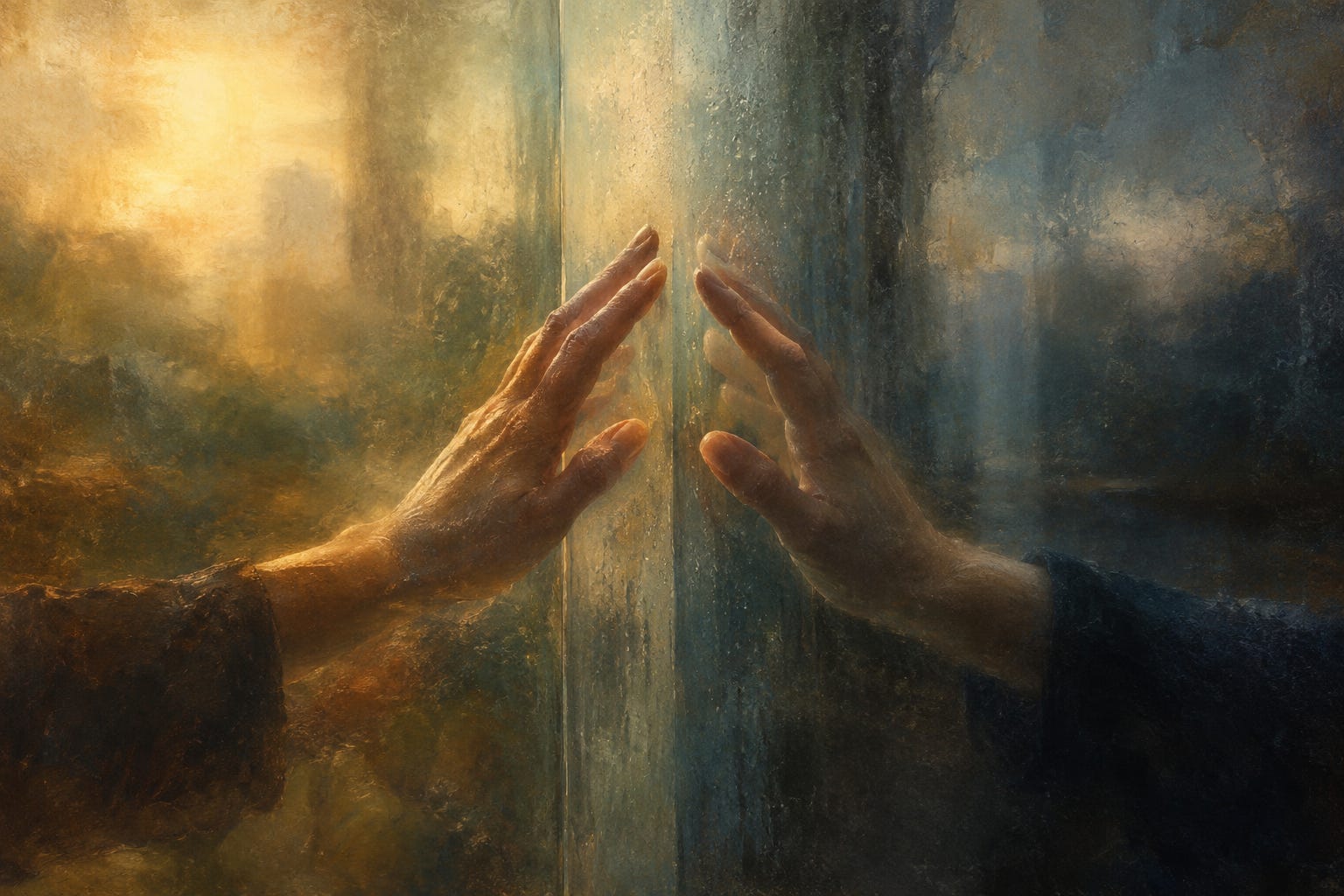
And yet we know from experience that, for us, it can’t — that proximity is required for love’s fullest expression. For all the wonders of Zoom — facial expression, tone of voice, immediacy — it isn’t just a pale version of being in person. It can actually accentuate the pain of separation, teasing an illusion of proximity where there is none. Like the people in a prison visiting room who press their hands to the glass as if to touch, you can be right there, in full view, and still inhabit a completely different world. It’s better than nothing. But it doesn’t work.
So here, I think, is what’s going on. Many spiritual traditions describe a kind of communion among souls unclothed by bodies — the soul’s life in the world to come, direct and unmediated. But that is not the mode we are in. We are, for now, embodied, and the body’s mediation of our love is inescapable. It is simply how we love here. Which means that when we are separated from those we love — for whatever reason — pain is not a malfunction. It’s built in. Given that we love through the body, to lose the bodily presence of the beloved is, definitionally, to suffer.
Notice what this does and doesn’t say. It doesn’t say the love has ceased to exist, or gone anywhere at all. The love is fully real, and fully intact. What it has lost is not its being but its accustomed expression — the face, the voice, the shared room, the thousand ordinary channels through which it used to flow. Like an electrical charge building in a thundercloud, love in a hovering state of potential desperately wants a place to land — and in separation, it finds none.
Applying all this to the two people I spoke with this week may at least help frame the pain they’re in. Both are suffering a loss of proximity — one by circumstance, one by choice. Each is an instance of the same mystery: a love that is wholly real and has, for the moment, nowhere to go. We human beings are natural conductors of this strange energy. More than that, it seems intrinsic to what we are — which is why we are so distraught when the circuit can’t complete.
None of this makes the loss hurt less. But it reframes it. The love they feel is not a mistake to be corrected or a wound to be closed. It is the realest thing about the whole situation, and it isn’t bankrupted by the loss of proximity. It remains — whole, and theirs, and unspent. In time, the conductor may find new ground: not a replacement for what was lost, and not an erasure of the grief, but new channels through which a lifelong capacity for love can move again. The old connection remains part of what made that possible. Nothing about the loss can take that away.