



Image: stockcake.com
About six months ago I was delighted (and somewhat stunned) to become a grandfather. Like most doting elders, I like to imagine that the little tyke is in possession of many of my qualities—physical or otherwise—but the more I observe him, the more he seems like “his own thing.” The most remarkable aspect of watching this tender life begin to unfold is the rapid emergence of awareness in such a brief span, and the fearless, dogged manner in which he absorbs the world.
From what I understand, babies live in a pre-conceptual universe. To them, everything is pure experience, with none of the narration, reflection, and judgment to which we subject all that happens to us. Lacking any conception of past or future, they inhabit that enviable dimension of “now” that many of us strive for—a now that has sensation without ownership, movement without intention, and comfort and distress without a story. What this shows is that awareness exists before identity. Experience precedes interpretation. As such—and importantly—only much later will this be called a body.
When the Body Appears
The wild thing is that for each and every one of us, the body’s appearance is a developmental event; it emerges over time. A baby’s awareness seamlessly blends into his surroundings; there is no felt distinction between himself and the world around him. Not unlike certain altered or contemplative states that adults later strive to induce, this unitive mode of consciousness is perfectly natural and primal. Over time—and especially as language allows us to store, compare, and analyze experience—boundaries begin to form. Sensations localize and repetition stabilizes perception. The striking thing is that the body is not discovered whole; it is assembled over time.
The case of Helen Keller is particularly useful to reflect on, in that she was not a baby when her symbolic sense of self “came online.” Before her “soul’s sudden awakening,” she described her world as “still” and “dark,” with “no strong sentiment or tenderness.” She was not without sensation, but without a framework capable of organizing it. I still don’t fully understand how Anne Sullivan helped her reach the conceptual breakthrough she did. I’ve seen the film and read Keller’s autobiography, yet the drama of that leap continues to astound me. In her own words:
I stood still, my whole attention fixed upon the motions of her fingers. Suddenly I felt a misty consciousness as of something forgotten—the thrill of a returning thought; and somehow, the mystery of language was revealed to me. I knew then that “w-a-t-e-r” meant the wonderful cool something that was flowing over my hand. That living word awakened my soul, gave it light, hope, joy, set it free!
In truth, we all do this as babies; we simply lack the symbolic container needed to store the experience. Subjectively, I suspect this offers a model for what it is like to break through to higher states of consciousness. Deep within our lived experience, we already know what such moments feel like, and with the right effort, mindset, and training, our own w-a-t-e-r moment may come. Like each infant, Keller did not awaken to consciousness—she awakened to the structure that would allow the storage and retrieval of her inner life.
In that instant of revelation, Keller did not merely gain words; she erected the scaffolding of identity and separation that would later define her embodied existence—precisely the ‘narrow chinks’ through which Blake believed we habitually glimpse reality, and which contemplative practice seeks to widen or dissolve.
The Marriage of Heaven and Hell
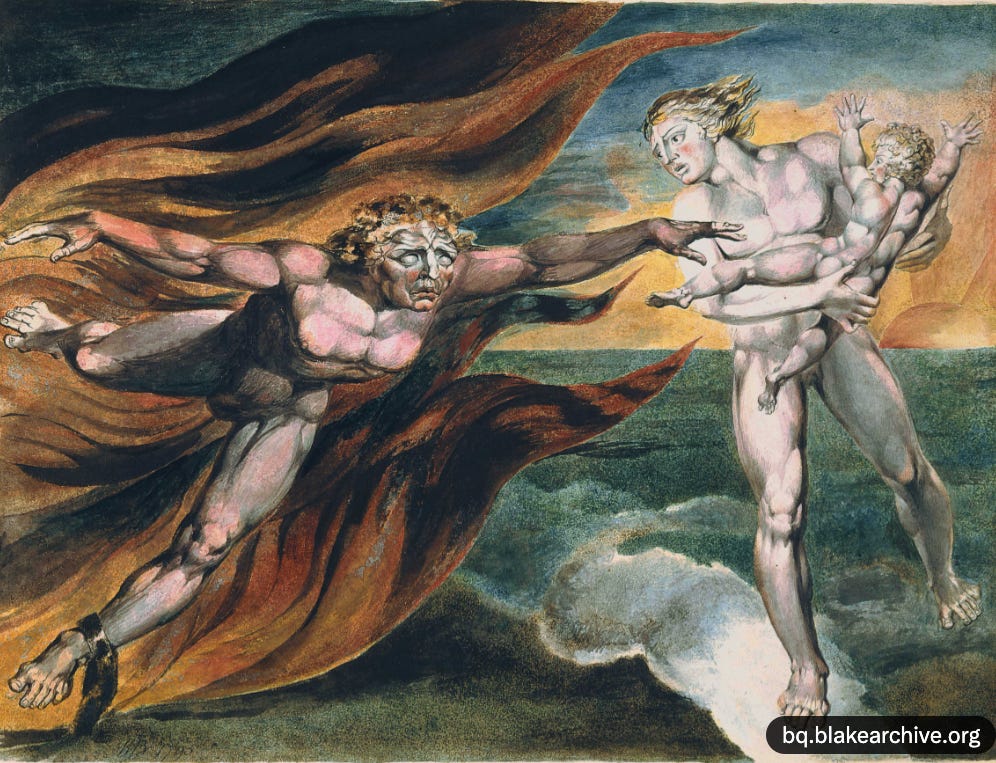
In his prophetic work The Marriage of Heaven and Hell, the mystical poet William Blake wrote that “Man has no Body distinct from his Soul; for that call’d Body is a portion of Soul discernd by the five Senses, the chief inlets of Soul in this age.” In a kind of dual-aspect monist view of human experience, he put forth the idea that the body is a mode of perception—a portion of the soul discerned through the senses.
To be clear, Blake is not suggesting that the body is illusory or that physical matter is unreal. Rather, he proposes that corporeal reality is part of a single continuum that presents itself across two domains: Heaven and Hell, or the spiritual and the physical. Perception manifests differently depending on where it is “located.” In this sense, the arc of a human life can be understood as moving from a relatively undifferentiated, pre-symbolic state (Heaven) toward an increasingly embodied and differentiated one (Hell), with the possibility of integrating both—what Blake might have called Heaven on Earth. Note: Blake celebrates energy and passion as “Hell;” it’s not pejorative here.
Another way of approaching this idea is through physics. Thanks to Einstein’s revolutionary insight, we now know that what we call matter is simply a form of condensed energy. It exists at one end of a continuum but is fundamentally the same as the energy from which it arises. Solidity, then, is not fundamental. Matter is a pattern that appears wholly distinct from energy, much as a prism gives rise to the illusion of separate colors or distance and velocity alter our perception of sound. In reality, there is only one thing present—manifesting differently depending on context.
Back to the Garden
Human beings have developed multiple ways of loosening the occluding influence of the body and reawakening our innate capacity to soften boundaries. The aim of meditation or psychedelic exploration is to glimpse, however briefly, the underlying continuity of experience. As Blake put it in the same work:
If the doors of perception were cleansed, every thing would appear to man as it is, Infinite. For man has closed himself up, till he sees all things thro’ narrow chinks of his cavern.
This is not an attempt to become an infant again. Rather, it is an effort to reduce the narrative self, dissolve rigid bodily boundaries, and heighten sensory immediacy. It is energy released from rigid form. What dissolves is not the body itself, but the idea of the body as fixed. Of course, such states are fleeting and do not abolish embodiment—but they remind us that the body is far more fluid than we habitually assume. Sensation does not merely occur in awareness—it is evidence that awareness was already there. Whatever makes sensation present cannot itself be reduced to sensation alone.
The body was never meant to be a prison, but a memory—of what awareness looks like when it slows itself down enough to take shape. We begin life knowing this without knowing that we know it, before language hardens experience into structure and identity. And every so often, through insight, practice, or grace, the boundaries soften again, and we remember—not by escaping the body, but by inhabiting it more fully, as something alive, fluid, and continuous with the awareness that first gave it form.
All 50 States: A Passport to Your Mind: A new program for paid subscribers.
Each week, you’ll get a guided exploration of a single state of mind — from everyday states like focus, flow, and daydreaming, to deeper emotional, meditative, and contemplative states we all pass through in the course of a human life.
Think of it like a map + travel guide:
1. Clusters / Regions (like US regions):
Everyday States = “The Lowlands” (common terrain of life).
Emotional States = “The Heartlands.”
Meditative States = “The Mountains” (higher elevations of awareness).
Altered / Substance-Induced States = “The Islands.”
Mystical / Transpersonal States = “The Skies.”
Extreme / Edge States = “The Deserts & Depths.”
(If you’re already a paid subscriber and would like to receive the All 50 States email, click here).
Yes...a superb essay. I used to think that the expression "unencumbered by the thought process" was somewhat of a dig. But man, it really is a blessing! In silence of the mind, the ego evaporates, albeit too briefly. "Be still and know that I am G-d". Thanks so much for this (and the other) pieces you've written.
A beautiful piece Adam!